Mildly irritating and occasionally amusing US sex columnist Dan Savage has recently initiated a project named 'It Gets Better'. Basically, fully grown gays, lesbians and celebrities (including Paris Hilton) create videos boasting about how comfortable adult life is for the benefit of LGBT teenagers. This has the rare distinction of being smug and wonderful, a sacrament of boasting in the face of oppression.
Which brings me onto the song that has plagued my mind for much of the past few months, 'Left To My Own Devices' by the Pet Shop Boys. It's extraordinary. Firstly, the vocals. Johnny Rotten was famously happy to declare that he didn't care, although the tone of this pronouncement belies his actual level of care. Neil Tennant is unique in all of pop music in being able to sound as though he genuinely doesn't give a thr'penny fuck about all of creation. Languid, bored, lazy, distant - it's all there.
Why doesn't Neil care? Well it's hinted at in the music - a cold fusion of musicals, opera and early house - and suggested in the lyrics - "this friend of mine - he's a party animal", "maybe if you're with me, we'll do some shopping". Neil doesn't care because his Pink Pound and Wildean mind have transcended all limitations placed on him, all fetters on his artistic production and impeccable taste. Finally, he is everything he meant to be and anyone who disagrees can fuck themselves and enjoy it. It's a wonder, and anyone who finds this irritating or distasteful has their bread buttered on the wrong side.
Showing posts with label pop. Show all posts
Showing posts with label pop. Show all posts
Friday, 8 October 2010

Tuesday, 21 July 2009
Album of the 'Week': 'Enema of the State'
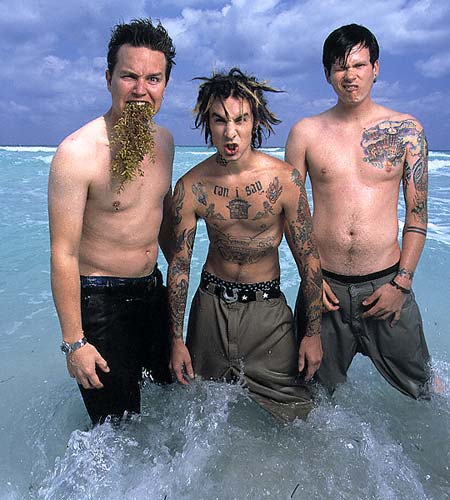
The notion of a guilty pleasure is a strange and degraded one. Obviously, there are things that you can't admit to in polite company, things that don't fit the criteria that society and you yourself set for enjoying things. But in admitting to a guilty pleasure, you are exposing these hidden passions - for this reason, people are squeamish about what they reveal. They might admit liking Eastenders or Desperate Housewives, but never Blink 182. Their bassist has a mouthful of fucking seaweed in the picture above, for crying out loud, and the album I'm writing about is called 'Enema of the State'.
Nevertheless, each of us has enjoyed music that seems repugnant in hindsight. Revisiting 'Enema of the State', the depth and breadth of sexism and puerility on display is truly shocking. Nu-metal, and the more sprightly and appealing pop-punk that developed alongside it at the beginning of this decade was in many ways the nadir of the macho posturing inherent in rock - a mixture of sweaty male bonding and inane self-pity that's truly off-putting to anyone with an ounce of decency.
However, I would argue that Blink 182's approach renders them a partially defensible pleasure. Unlike Limp Bizkit, Blink 182 have enough sense to make themselves the butt of the joke. The frat-house nonsense that infects the album is punctured by songs like 'What's My Age Again?', which demonstrates a degree of self-knowledge and self-doubt that makes the homophobia and sexism a bit more palatable. There's also a clear pop sensibility at play, which made the music an anathema to dull, mohawked punks and the traditional tween audience of pop. Their relative musical and lyrical idiocy also leads to the inclusion of a genuinely pathetic and upsetting song about teen suicide (appalling punks with the use of keyboards).
This was Blink 182's musical highpoint, and it's been downhill from there. The traditional cliché about American culture (oft-spouted by the BBC) is that the American Dream remains upstanding, despite the many disproofs that exist. The pop-punk version of the American Dream as presented by 'Enema of the State' seems closer to the fact - myriad flaws and disgusting attitudes, covered by a surface sheen that is, in my case, irresistible.
Thursday, 18 June 2009
Album of the 'Week': 'Journal For Plague Lovers'

The Manic Street Preachers are, as Simon Price argues in his brilliant and infuriating masterwork 'Everything', the band that mattered the most to their fans since The Smiths. Arguably this title was wrestled from them by The Libertines, partially because The Libertines are more interesting in terms of narrative, but largely because of the Manics' truly staggering backslide in terms of musical quality.
From 1994's 'The Holy Bible' to 1999's 'This Is My Truth, Tell Me Yours' (an album with a title long enough to merit a comma) the Manics made scythingly beautiful pop music, allied to gauché and memorable lyrics - their grandiosity and naivité making them the perfect antidote to Britpop's music-hall/football crowd stylings. Then came one of the worst albums ever made by a great band, and my personal departure from the Manics, 'Know Your Enemy'. Mere words cannot describe how shit the album is, but they can go some way. It was clattering, pretentious, ugly and stupid - it contained songs defending the former Soviet Union and attacking Royal Correspondents (how controversial!). This album was trailed as a return to form - it arrived as a terrible disappointment. I'd like to deride the albums released since 'Know Your Enemy', but I've scarcely heard them - they have some good songs, but that does not make them worth weathering.
So, another album, another return to form. 'Journal For Plague Lovers' re-engaged the music press and lapsed fans through a wonderful piece of grave-robbing, using for its lyrics notebooks bequeathed to the band by missing lyricist and guitarist Richey Edwards. The look and sound of the album is clearly based on that of 'The Holy Bible', the last Edwards-era Manics album, and it delivers on the promise. If it's merely an exercise in nostalgia, it's an exercise which has led them back to the well of decent music, from the lake of shite where, for a decade, they have pitched camp.
The lyrics of 'Journal For Plague Lovers', compared to their contemporaries used on 'The Holy Bible', lack density and focus. Whereas 'The Holy Bible' offers lists of demagogues, 'Journal For Plague Lovers' gives us jokes - "me and Stephen Hawking...we missed the Sex Revolution when we failed the physical". Some of the lyrics would have benefited immensely from being left in the book - Doors Closing Slowly's opening couplet "Realise how lonely this is/Self-defeating? Oh fuck yeah" is one of the worst lyrics ever committed to tape. There are still flashes of brilliance - "the Levi jean will always/be stronger than the Uzi" being a particular favourite - but the lyrics feel like what they are - the unwisely opened notebooks of a sadly insane man.
What has kept me listening to this album is what keeps all fans of the Manics listening to the Manics - the world-beating songwriting and singing of James-Dean Bradfield. On 'Journal For Plague Lovers' the discrepency in quality between the two elements of the songs becomes absurd. On 'Me and Stephen Hawking', James-Dean's giddy verses, sung at the edge of his vocal range, are a joy - the lyrics, including the phrase "Transgenic milk containing human protein", are an irritant. The anthemic 'Jackie Collins Existential Question Time' has a lyric which at first is amusing and becomes, through repetition, an annoyance ("if a married man fucks a Catholic"). But, give or take a few skipables, the Manics have made an album that repays listening, a fact as wonderful as it is unnerving.
Wednesday, 15 April 2009
Album of the Week: 'Armed Forces'
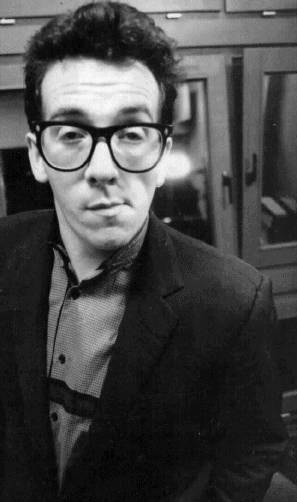
Elvis Costello is perhaps the most respected songwriter to emerge from the punk era - a status he has achieved by spending the last 15 years or so behaving like an apprentice Paul McCartney. He has recorded albums with string quartets and Allen Toussaint, written orchestral music and, most recently, acted like King Music on his good but grating 'chat show' Spectacle. Much of his more recent work has involved carefully rounding off the razor-sharp edge that his music previously had, and re-presenting himself as an all too conscious 'musician'. He is not, however much he may like to think he is, a middle-of-the-road tunesmith - his music is not made for wedding receptions. Costello famously remarked, around the time of the release of his first 3 albums, that he was capable of two emotions - guilt, and revenge. 'Armed Forces' deals with these, brutally and relentlessly.
One reason 'Armed Forces' stands apart from the other early Elvis albums, is hinted at in its title, and blugeoned home in the thankfully discarded provisional title, 'Emotional Fascism'. As well as referring to snatches of broken, destructive relationships, the ghosts of World War Two and the stasis of the social contract that emerged following are pressed into service. In perhaps the album's weakest track, 'Chemistry Class' - a poor, disjointed song of obsessive love and heartbreak - the chorus runs "Are you ready for the final solution?". Fortunately, this disgrace is a rare blip - the interplay between the political and personal is more stylishly done in the glittering 'Oliver's Army', which draws a parallel between the drunken rambling of an old soldier and the decline of the British Empire. The political extremity of the coming Thatcher revolution and the rise of the NF is dealt with in the itchy, fearful 'Green Shirt' and the fabulous 'Sunday's Best', which imagines a particular British seaside fascism of "Songs of Praise and Reader's Wives", where natives "beat up strangers who talk funny - take their greasy, foreign money".
Of course, this all sounds rather worthy, which is where the other half of the album's content comes into play. During the recording of 'Armed Forces', Costello is on record as having been under the influence of Abba. Unlike the dry, clattering, Americanised rock of 'My Aim Is True' and 'This Year's Model', 'Armed Forces' is a lush, harmonied and synthesisered work. This explains the enduring status of 'Oliver's Army' and 'Accidents Will Happen' as his most recognizable songs. It also acts as a glorious counterpoint to the grime and sweat of the subject matter - the peppy sequencing and cut glass chords of 'Green Shirt' makes lyrical punches like "better cut off all identifying labels/before they put you on the torture table" easier to weather. The grand horror of the lyrics next to the horror of the subject matter fits into the famous 'Peep Show' framework of brown toast for dinner, and white toast for dessert. The joke is on him, because I actually love brown toast.

Sunday, 22 March 2009
Album of the Week: 'Fear of Music'

Talking Heads were unique among their punk contempories in their childishness and playfulness. This fizzled out by the time of their most acclaimed album, 'Remain In Light', and lead to some of their output being unlistenable cock ('More Songs About Buildings and Food' being useless). Luckily, they had a last fun hurrah with 'Fear of Music', which also contains their most enjoyable music.
'Fear of Music' is 'a Brian Eno Production', and those who wonder where his unblemishable reputation comes from, this and David Bowie's 'Low', from the same period - staggeringly different, both wonderful - are the place to start. The man can churn out as many Coldplay and U2 albums as he inexplicably wants to, with these in the bank. Unfortunately, all the links available are live performances, but see 'Drugs', the closing track, which is like no guitar music before or since.
Aside from 'Drugs' and 'Heaven', the songs on 'Fear of Music' are funk, or at least funky - a path they followed with ever diminishing returns - but here, it sparkles with energy and invention. Eno adds another dimension, spinning synthesisers and wrapping tape around their spindly, excitable funk, highlighting the quirk of the subject matter and the oddity of David Byrne's breathless vocal.
The songs, named with idiot simplicity ('Drugs, 'Animals', 'Cities'), have lyrics that take off at right-angles from their blank titles. It's easy to imagine, say, a Motley Crew (why should I spell their name wrong, like they choose to do?) song named 'Animals', boasting of their rock and roll lifestyles, with a video featuring motorbikes somehow. Talking Heads, however, give a first person monologue from someone who anthropomorphises, then detests animals, claims that "they're making a fool of us" and that "they're setting a bad example" by "[shitting] on the ground". You could imagine into existance a song by Manic Street Preachers named 'Cities', grandiose and bestringed, with James Dean Bradfield wailing about the alienation and beauty of large conurbations. In the hands of David Byrne, 'Cities' becomes a young adult fantasy about moving to different cities, noting of Birmingham, Alabama, that it has a "dry ice factory - good place to get some thinking done!". Childish enthusiasm is the main emotion you're left with, something which, when feigned by adults, is usually grating. Here, it's just glorious, and seemingly sincere.
Subscribe to:
Posts (Atom)
