Showing posts with label America. Show all posts

Tuesday, 21 July 2009

Album of the 'Week': 'Enema of the State'


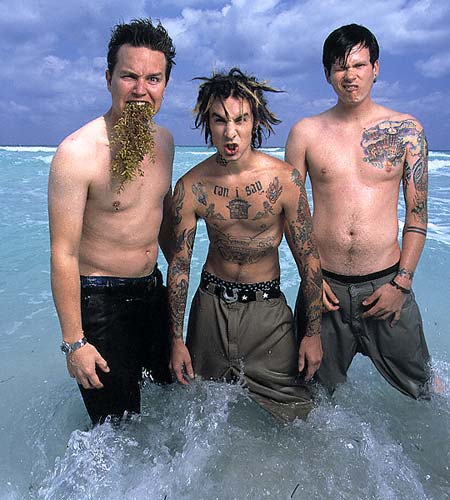
The notion of a guilty pleasure is a strange and degraded one. Obviously, there are things that you can't admit to in polite company, things that don't fit the criteria that society and you yourself set for enjoying things. But in admitting to a guilty pleasure, you are exposing these hidden passions - for this reason, people are squeamish about what they reveal. They might admit liking Eastenders or Desperate Housewives, but never Blink 182. Their bassist has a mouthful of fucking seaweed in the picture above, for crying out loud, and the album I'm writing about is called 'Enema of the State'.

Nevertheless, each of us has enjoyed music that seems repugnant in hindsight. Revisiting 'Enema of the State', the depth and breadth of sexism and puerility on display is truly shocking. Nu-metal, and the more sprightly and appealing pop-punk that developed alongside it at the beginning of this decade was in many ways the nadir of the macho posturing inherent in rock - a mixture of sweaty male bonding and inane self-pity that's truly off-putting to anyone with an ounce of decency.

However, I would argue that Blink 182's approach renders them a partially defensible pleasure. Unlike Limp Bizkit, Blink 182 have enough sense to make themselves the butt of the joke. The frat-house nonsense that infects the album is punctured by songs like 'What's My Age Again?', which demonstrates a degree of self-knowledge and self-doubt that makes the homophobia and sexism a bit more palatable. There's also a clear pop sensibility at play, which made the music an anathema to dull, mohawked punks and the traditional tween audience of pop. Their relative musical and lyrical idiocy also leads to the inclusion of a genuinely pathetic and upsetting song about teen suicide (appalling punks with the use of keyboards).

This was Blink 182's musical highpoint, and it's been downhill from there. The traditional cliché about American culture (oft-spouted by the BBC) is that the American Dream remains upstanding, despite the many disproofs that exist. The pop-punk version of the American Dream as presented by 'Enema of the State' seems closer to the fact - myriad flaws and disgusting attitudes, covered by a surface sheen that is, in my case, irresistible.

Monday, 20 July 2009

There's a good war!

The War in Afghanistan, being the new focus of the US and UK, is quickly shooting up the agenda. Much of the debate recently has focused on the lack of equipment for our boys, primarily the lack of helicopters. There should be a massive increase in helicopters, and they should be used to lift 'our boys' out of a depraved war. The focus given to Afghanistan by President Obama and the increasing severity of the situation in 'Af-Pak' has led to a rather fine upsurge of oppositional literature on the topic. Firstly, Tariq Ali's general piece from 2007, in the beautifully presented, but ever infuriating New Left Review and his more Pakistan-focused 'diary' in this fortnight's London Review of Books. Hitting a more rabble-rousing and less self-obsessed note is Jonathan Neale's wonderfully simple overview of the issues, actors and factors that make up the situation. The feat of this piece is that an 8-year-old could come out the other end of it, and know more about Afghanistan than George W. Bush.

Finally, and on a more bloggy note, the magnificently named Lenin on the crassness of the inevitability argument - a kind of Vietnam syndrome of the left, where any war in difficult territory, with an opposition, will lead to US defeat. The comments section is, as always, worth reading - proof that, however problematic the anti-Iraq war campaign was, the left remains capable of losing its bearings faced with 'the Good war'.

Friday, 17 April 2009

Approaching Gore Vidal: Part 2, 'Selected Writings'


Gore Vidal's politics are probably the most intriguing thing about the man. An odd kind of Democrat, he has vehemently opposed America's intervention in all wars including WWII, correctly regards the US an empire, and believes in the legalisation of all drugs. When his personal life is factored in, it is impossible to believe that he was a friend of the Kennedys and Clintons, and a congressional candidate. But, class counts in the States, despite the lunatic pronouncements of pro-Americans on the subject of the American Dream, which is, and has always been a dream.

'Selected Writings', never less than entertaining, collects Gore's writings on books and politics, largely sidestepping Gore's name-dropping, aristocratic side. Of course, these are more than one side of the man (probably nearer 2/3rds), and they creep in - an eyewitness account of 50s Egypt is by turns a travelogue of the kind popularised (?) by Michael Winner and a breathtakingly detailed exposition of superpower rivalry, coming to the then radical conclusion that money, not politics, was the determining factor. A brilliant, before-its-time (1981!) attack on the homophobia and racism of one of the original neo-cons, Norman Podhoretz, 'Pink Triangle and Yellow Star' (exerpt here), is marred by Vidal's compulsion to mock Podhoretz and his wife, Midge Decter, for being nouveau riche, of 'the new class' - not Mayflower originals like the Grand Old Gores.

Vidal's radicalism is absurdly wide-ranging, ranging from attacks on what he calls The Family to ending an essay on 9/11 with a simple, and gigantic, table of US interventions in the 10 years preceeding the attacks. In the same essay, the pre-9/11 Bush is compared to Hitler. Reading Gore's more recent work, the motivation behind his surreal election night face-off with David Dimbleby becomes blindingly clear.

Vidal has bitten off a large chunk of extreme libertarian thought - during the Clinton years, he famously associated with the survivalist convicted of the Oklahoma Bombings. He therefore expresses his anti-imperialism in the tones of one who accepts the Israel Lobby thesis, with touches of New World Order 'theory'. Added to this a fierce (and inexplicable) support for the Democrats, Bush became, to Gore, a fascist dictator, clamping down on dissent, launching criminal wars. While Bush undoubtably did this, Gore saw Bush and the Republican party as cancers on America, and not a logical outgrowth. When the Republicans were defeated at the polls, all the totalitarianism that had been determined by Gore - the theft of the 2000/2004 elections by Republican 'criminals' vanished into smoke. A fascist party that gets peacefully replaced by its rivals, isn't a fascist party.

Wednesday, 1 April 2009

"Ask not what your country can do for you"

The BBC have recently been showing a profoundly disturbing advert, as part of the promotion for their thoroughly ill-judged 'Britain's Got Talent' style search for the next great orator. Disturbing, first, for the shift between the ordinary voice of a child and the voice of the corrupt mayor of Springfield, Joe Quimby. But also disturbing in its content - the end of John F. Kennedy's inaugural address, in which he beseeches his citizens not to ask him for things ("ask not what your country can do for you, but what you can do for your country).

JFK is seen by some as a lost liberal hero - his assassination an attack on a reforming politician by the forces of reaction. The unimpeachable Marvin Gaye and Bill Hicks fell down on this camp (in fairness, Hicks had reservations). He was none of these things. Like Tony Blair, he took it upon himself to be more hawkish than the hawks, sending troops against Cuba and Vietnam. Two major invasions in just shy of 3 years is an impressive record.

The section of his speech chosen by the BBC to highlight great oratory is in fact apocalyptic, nonsensical and platitudinous. He tasks himself with "defending freedom in its hour of maximum danger", assuring the audience that "I do not shank from this responsibilty". Of course, this proved not to mean the freedom of Cuba and Vietnam to determine their own futures, although both of them managed to achieve an impressive degree of self-determination faced with the greatest military force the modern world has known. Aside from these churlish objections, what can Kennedy mean about freedom being in its hour of maximum danger in 1961? Surely we can agree that was, in modern history, when Hitler's armies had an iron grip over the vast swathe of continental Europe, with Kennedy's father's full support?

After dropping this millinarian clanger, he tries to sweeten his audience by praising their generation - "I do not believe that any of us would exchange places with any other people or any other generation". This is, over human history, largely true - the fact of technological progress, and the impossibility of time travel make exchanging places with other generations both undesirable and impractical.

But the most arresting phrase, and the most infuriating, is his call for Americans not to ask what their country can do for them, but what they can do for their country. The state behaves, at its most basic level, as a parasite. In the feudal era, the state acted as a protection racket, demanding taxes, and punishing those
who refused to cough up. Fortunately, things are less one-sided now, following demands on the state to provide essential services, and a degree of security. Arguing for self-sacrifice in the name of the glory of the nation, must have, should have, sounded slightly kamikaze to an audience of people, many of whom had been detrimentally impacted by the struggle against oriental despotism.

Given that the rise of Obama is clearly the impetus for the BBC's search for an orator, the choice of this speech is highly ironic - Obama's arguments are almost opposite to those of Kennedy. Obama argued against fearful patriotic fervor in the form of the Iraq War, and for state intervention to help create jobs and widen health-care provision. Not counting the incongruity of JFK's nasal, Bostonian tones issuing from the maws of clearly British children, the speech hits the wrong notes.