Tomorrow, US troops will 'pullback' from towns and cities in Iraq. Good taste surely dictates that the celebrations will be muted - throwing a giant parade, given the million dead and 2 million displaced, would be quite grotesque (I foolishly searched for an image for this post, using the terms 'Iraq War' - not a clever move). The Iraq War (or 'Iraq 2 - This Time, It's Protracted') is seen, by all other than the most ostrich-like supporters of the invasion, as an unmitigated disaster - the deposition and execution of Saddam being scant consolation for the utter destruction of infrastructure, the creation of a sham 'democracy' and the unleashing of inter-communal violence. All of the main governmental supporters of the war: Bush, Blair and Aznar, are now out of office.
The election of an American President who was opposed to the war, and the 'pullback', are drawing a line under the invasion - continued criticism of the war will henceforth appear to be, if not sour grapes, then an increasingly irrelevant irritant. Of course, US troops remain in Iraq, as will the aircraft that rain fire indiscriminately and the branches of KFC. The message is that it's over - the massage of the message from the pro-war crowd will be "we came with good intentions, but got it wrong. Better luck next time!". They'd prefer not to learn the lessons, as they didn't after Kosovo, as they won't after Afghanistan. It's a shame, as I maintain a sedentary lifestyle, and really hate marching, even against war, but needs must.
One problem for the anti-war movement is film. The director and critic Francois Truffaut argued that it is impossible to make an anti-war film, as film can't fail but make look war look exciting. I've always taken this argument as fact - if we look at Apocalypse Now!, all 'the horror, the horror' is balanced with wide shots of helicopters, Flight of The Valkyries and that. Platoon, despite Oliver Stone's pinko-commie ways, leaves us with a slo-mo death scene that makes the chemical squalor of US conduct in Vietnam seem like the greatest heroism. But the Iraq War, for all the horror it's wrought, has left us with a genuinely anti-war film in the form of Paul Haggis' mesmeric 'In The Valley of Elah'.
'In The Valley of Elah' achieves its stance against the war by not setting its film in Iraq - the battered country is only seen in cameraphone footage, grimly reminiscent of leaked footage of so much atrocity. However, Iraq has come home - the film is set on a sunblasted army base, as disconnected from the US as the troops stationed thousands of miles away. Tommy Lee Jones plays the protagonist, the father of an Iraq veteran, and the narrative takes the form of a police procedural. The heavy lifting of the piece is undertaken by Tommy Lee's face, shown in nearly perpetual close-up, and his face's performance is magnificent. It's been said of the jazz pianist Cecil Taylor that he's capable of playing different tempo, tone and volume on each finger. In 'Elah', Tommy Lee Jones does the same thing with each facial muscle.
The film is remarkable for its portrayal of soldiers as human beings. Despite the millenia old existence of armies, this remains a difficulty (see the film '300' if you don't believe me). Perhaps it's because the things which armies do are beyond human - it's hard to believe that the people who razed Fallujah are of made of flesh like ours. But they are - they drink, they fight, they cry, they grieve and love. In a sane society, we wouldn't need an Armed Forces Day, or a Veterans' Day. We'd simply remove these individuals from the hideous situations in which they are placed, and carry about our business.
In dealing with the aftermath of war, 'In The Valley Of Elah' makes war as unsexy as it should be, and by implication, makes the decision to prosecute wars of choice seem as psychotic as it truly is. The film is problematic in its almost exclusive focus on the suffering of Americans. This is an imbalance that we can presume will exist until Iraq becomes the Las Vegas on the Gulf that we are promised. But in its unflinching portrait of what becomes even of the prosecutors of war, it deserves attention and acclaim.
Showing posts with label war. Show all posts
Showing posts with label war. Show all posts
Tuesday, 30 June 2009

Wednesday, 15 April 2009
Album of the Week: 'Armed Forces'
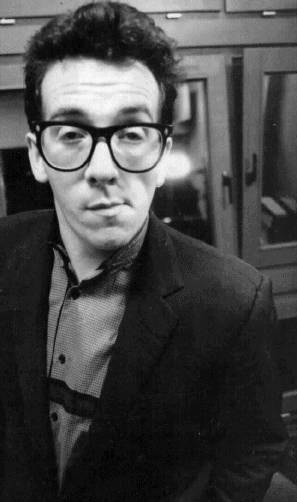
Elvis Costello is perhaps the most respected songwriter to emerge from the punk era - a status he has achieved by spending the last 15 years or so behaving like an apprentice Paul McCartney. He has recorded albums with string quartets and Allen Toussaint, written orchestral music and, most recently, acted like King Music on his good but grating 'chat show' Spectacle. Much of his more recent work has involved carefully rounding off the razor-sharp edge that his music previously had, and re-presenting himself as an all too conscious 'musician'. He is not, however much he may like to think he is, a middle-of-the-road tunesmith - his music is not made for wedding receptions. Costello famously remarked, around the time of the release of his first 3 albums, that he was capable of two emotions - guilt, and revenge. 'Armed Forces' deals with these, brutally and relentlessly.
One reason 'Armed Forces' stands apart from the other early Elvis albums, is hinted at in its title, and blugeoned home in the thankfully discarded provisional title, 'Emotional Fascism'. As well as referring to snatches of broken, destructive relationships, the ghosts of World War Two and the stasis of the social contract that emerged following are pressed into service. In perhaps the album's weakest track, 'Chemistry Class' - a poor, disjointed song of obsessive love and heartbreak - the chorus runs "Are you ready for the final solution?". Fortunately, this disgrace is a rare blip - the interplay between the political and personal is more stylishly done in the glittering 'Oliver's Army', which draws a parallel between the drunken rambling of an old soldier and the decline of the British Empire. The political extremity of the coming Thatcher revolution and the rise of the NF is dealt with in the itchy, fearful 'Green Shirt' and the fabulous 'Sunday's Best', which imagines a particular British seaside fascism of "Songs of Praise and Reader's Wives", where natives "beat up strangers who talk funny - take their greasy, foreign money".
Of course, this all sounds rather worthy, which is where the other half of the album's content comes into play. During the recording of 'Armed Forces', Costello is on record as having been under the influence of Abba. Unlike the dry, clattering, Americanised rock of 'My Aim Is True' and 'This Year's Model', 'Armed Forces' is a lush, harmonied and synthesisered work. This explains the enduring status of 'Oliver's Army' and 'Accidents Will Happen' as his most recognizable songs. It also acts as a glorious counterpoint to the grime and sweat of the subject matter - the peppy sequencing and cut glass chords of 'Green Shirt' makes lyrical punches like "better cut off all identifying labels/before they put you on the torture table" easier to weather. The grand horror of the lyrics next to the horror of the subject matter fits into the famous 'Peep Show' framework of brown toast for dinner, and white toast for dessert. The joke is on him, because I actually love brown toast.

Subscribe to:
Posts (Atom)
