On hearing the Manics announce another 'indefinite hiatus' recently, I thought of one of the many reasons why Bono is a tosser. On the release of one of their many interchangeable, pleasant albums, Bono remarked that he was "re-applying for the job of the Best Band in the World'. The thought that this role is something that one can apply for sums up everything that's wrong with Bono. You can imagine him, sat in some neutrally decorated reception somewhere, running over his just-affecting-enough lines, smoothing his sensible hair and polishing his rebellious shades (hinting at the morning after) before entering to a panel of elder statesmen and listing his merits. The Manics, in contrast, wanted nothing more than to be the Best Band in the World and failed. If only they'd not mentioned the Holocaust repeatedly in the interview, they might have been ok. The Manics really wanted to be the Best Band in the World, whereas Bono wanted to get the job to pad his CV when he applies to be Pope.
The Manics wanted to be the Best Band in the World because rock music really mattered to them, as it does to millions of people in derided backwaters all over the world. The openness and freedom matters when your horizons feel very near, the chord hangs on long enough to suggest a future and a far-away, a happy-ever-after. They added to this, a resolute refusal to patronise their listeners (which is why their fans adore them, and I'm writing this now).
Think of Bruce Springsteen, and the words he puts into the mouth of the protagonist of Thunder Road. Addressing his beloved, he mumbles "You ain't a beauty/but hey, you're alright". Now, the Manics' protagonist responds: "Life is full of cold made warm and they are just lizards"; "Anxiety is freedom"; "Rock and roll is our epiphany/of culture, alienation, boredom and despair". The mode remains the same, now weaponised by intellect, fortified by reading. The refusal to accept that living in a back end of arse-nowhere meant a focus on your own bubble, an ignorance of the rest of the world.
Of course, for Manics fans, the period where they meant that is long gone, and the above paragraph is mere jumpers for goalposts stuff. But even when the Manics changed course and turned inward, it was done with a lacerating lack of self-regard, another reason why they couldn't be the Best Band in the World. Their last truly great album, This Is My Truth Tell Me Yours, dealt relentlessly with the possible suicide by drowning of their hitherto most important member. The perversity of naming songs "Ready For Drowning and "Tsunami" in this context is admirable. The specificity of this album makes it a fucking miracle it ever got the Number One. Everything must go, never say goodbye, drift away and die.
Except they didn't, and wouldn't. The Manics have trundled on for more than ten years making songs that sound a bit like ones that they made when they were great. The best album was based on the work of their departed comrade. Their best songs, Indian Summer and Postcard from a Young Man, have sounded like goodbyes. So, goodbye.
Tuesday, 27 September 2011

Friday, 29 April 2011
Album of the Week: Community Music

Perhaps it wasn't the best idea to go on holiday the week leading up to the Royal Wedding. Watching BBC World on hotel television was like viewing a distant, strange culture. On my return, my workplace was filled with bunting and minature Union Jacks, like the inside of William Hague's mind. But unlike William Hague's mind, it was in no way uncritical, self-satisfied and smug. Cynicism was, as always in these instances, the default reaction of my collegues and most folk. An astonishment and grinding irritation, bourne of the entire media reminding you that you are, in actual, legal fact, lower than others. If a millionaire a commoner, what the fuck is someone on minimum wage?
Perhaps it doesn't help to live in one of the Kingdom's peripheries, where notions of national identity are dual, making an idea of a national celebration a conflict at least. Whatever it was, the Royal Wedding made me angrier than a lot of more justified causes. The Wedding seemed like the horseshit cherry on top of the bullshit sundae of a decades long handwringing panic on the part of our rulers.
Whether it's Thatcher's migrant swamp, Blunkett's concern that immigrants continue to speak other (oh so other) languages at home, Tebbit's cricket test, British jobs for British workers, old maids cycling past village greens pissed on warm beer etc. etc. etc., our rulers express continual concern that the British, or, whisper it, the 'British', aren't trying hard enough to be British. This is proposterous, in no way their role, and should be spat on whenever it rears its grotesque and in no small part racist head.
This absurd spectacle, with its preemptive arrests for anyone who dares criticise it in an excessively visual fashion, marks its high point. After a near half century of spurious attempts to define Britishness as based upon human rights, democracy, fair play and the like, the wedding of an unelected posh bellend (as opposed to all the elected ones), visited by war criminals and autocrats and paid for by commoners has supposedly united and defined us all as British.
Pass the sick bag, and if you can hear over the sounds of my wretching and ranting, listen to this, this, and this. It may, for a fleeting second, make you feel glad to be British.
Monday, 21 March 2011
Album of the 'Week': Graceland
When does politics interrupt music? The short answer to that is: when you're listening to it in my presence. The interaction between politics and music fascinates me, and bad politics in particular. On hearing a bar of Billy Joel's 'Just The Way You Are', I will, regardless of circumstance or propriety, explain how it's a sexist Trojan Horse, sneaking in controlling impulses and a heavily gendered idea of what women are for under its calm-sea sheen ("I don't want clever, conversation/Just cook my dinner right you bitch). As for 10CC's 'Dreadlock Holiday', well, the problems with that really shouldn't need explaining.
However, those songs are politically dreadful AND shit. Graceland by Paul Simon is one of the first albums I ever loved, but on listening to it recently, it was interrupted by politics. A low level buzz of wan, patronising and ill-judged politics defines the album as much as beauty and lazy refinement. For the best example, see 'Under African Skies', a haunting melody, an earworm beyond compare. Now, take its lyrics. A protagonist named Joseph is introduced and it is established that he is black and African. That is all. "The roots of rhythm remain" indeed.
Yes, this is Paul Simon's Black Album. The international legal issue around its creation is less problematic frankly - the sheer amount of hairshirted gesture politics that followed his seemingly ignorant breaking of the UN Cultural Embargo on South Africa (playing gigs outside of SA with the cream of exile talent, playing for the ANC in exile in Zimbabwe, ending all shows with the ANC anthem - check, check and check) surely made up for that. The problem more the embedded power of going somewhere with the intention of picking its talent like the coolest kid in class, and the idea of specifically yoinking players on the basis of their cultural/racial heritage. Not exactly wrong, but disquieting nevertheless.
This disquiet pervades the album. The disconnect between Simon's aging hippy lyrics, a thoroughly different musical tradition and the now laughable hi-tech of yesterday's tomorrow creates an extra queasyness and leaves behind a genuinely uncanny music. 'The Boy in the Bubble', with its dislocated pump of accordion and bass, drums synthesised and shifting volume without logic, and a lapsed idealist straining for a political point, ranks #1 in my Oddest Records of the 20th Century. And that century contained 'Ride A White Swan'.
Of course, this is criticism masquerading as praise. The real reason why I love this political and musical experiment (apart from the fact that it's a political and musical experiment) is its humility. From 'Graceland', a rare break-up song that doesn't idealise or despise either party, to 'You Can Call Me Al' - wherein a person undergoing a mid-life crisis is redeemed by the horror of the Third World ("scatterings and orphanages") - the whole album is deep structured by the lack of confidence of its narrator, their crippling fears and very timid hopes. For that, and the bass playing, this album repays listening by anyone who may be put off because of 'Scarborough Fair', the subsequent hi-jinx of Bono and Geldof and the undignified parp of synth brass.
However, those songs are politically dreadful AND shit. Graceland by Paul Simon is one of the first albums I ever loved, but on listening to it recently, it was interrupted by politics. A low level buzz of wan, patronising and ill-judged politics defines the album as much as beauty and lazy refinement. For the best example, see 'Under African Skies', a haunting melody, an earworm beyond compare. Now, take its lyrics. A protagonist named Joseph is introduced and it is established that he is black and African. That is all. "The roots of rhythm remain" indeed.
Yes, this is Paul Simon's Black Album. The international legal issue around its creation is less problematic frankly - the sheer amount of hairshirted gesture politics that followed his seemingly ignorant breaking of the UN Cultural Embargo on South Africa (playing gigs outside of SA with the cream of exile talent, playing for the ANC in exile in Zimbabwe, ending all shows with the ANC anthem - check, check and check) surely made up for that. The problem more the embedded power of going somewhere with the intention of picking its talent like the coolest kid in class, and the idea of specifically yoinking players on the basis of their cultural/racial heritage. Not exactly wrong, but disquieting nevertheless.
This disquiet pervades the album. The disconnect between Simon's aging hippy lyrics, a thoroughly different musical tradition and the now laughable hi-tech of yesterday's tomorrow creates an extra queasyness and leaves behind a genuinely uncanny music. 'The Boy in the Bubble', with its dislocated pump of accordion and bass, drums synthesised and shifting volume without logic, and a lapsed idealist straining for a political point, ranks #1 in my Oddest Records of the 20th Century. And that century contained 'Ride A White Swan'.
Of course, this is criticism masquerading as praise. The real reason why I love this political and musical experiment (apart from the fact that it's a political and musical experiment) is its humility. From 'Graceland', a rare break-up song that doesn't idealise or despise either party, to 'You Can Call Me Al' - wherein a person undergoing a mid-life crisis is redeemed by the horror of the Third World ("scatterings and orphanages") - the whole album is deep structured by the lack of confidence of its narrator, their crippling fears and very timid hopes. For that, and the bass playing, this album repays listening by anyone who may be put off because of 'Scarborough Fair', the subsequent hi-jinx of Bono and Geldof and the undignified parp of synth brass.
Tuesday, 15 March 2011
On Colonialism
An upcoming cricket match has reminded me of a deeply illustrative bit of commentary from the 2009 test match series between the West Indies and England. In a West Indian innings during a limited overs match, the Windies were having one of their sadly all-too-rare periods where they surpass what is expected of the game, and begin scoring and hitting wildly for no loss. These are also the moments where cricket becomes the most entertaining sport on earth.
The English commentary team shifted in their seats for a few overs, audibly strategised, and decided that this was frankly disrespectful - to the bowlers, of course, but most importantly to the game. Grumbling continued, then, in one over, Kevin Pietersen achieved three successive wickets. The commentators could not have been more delighted. Order had been restored, and the underdog lay beaten.
The English commentary team shifted in their seats for a few overs, audibly strategised, and decided that this was frankly disrespectful - to the bowlers, of course, but most importantly to the game. Grumbling continued, then, in one over, Kevin Pietersen achieved three successive wickets. The commentators could not have been more delighted. Order had been restored, and the underdog lay beaten.
Friday, 8 October 2010
It Gets Better: 'Left To My Own Devices'
Mildly irritating and occasionally amusing US sex columnist Dan Savage has recently initiated a project named 'It Gets Better'. Basically, fully grown gays, lesbians and celebrities (including Paris Hilton) create videos boasting about how comfortable adult life is for the benefit of LGBT teenagers. This has the rare distinction of being smug and wonderful, a sacrament of boasting in the face of oppression.
Which brings me onto the song that has plagued my mind for much of the past few months, 'Left To My Own Devices' by the Pet Shop Boys. It's extraordinary. Firstly, the vocals. Johnny Rotten was famously happy to declare that he didn't care, although the tone of this pronouncement belies his actual level of care. Neil Tennant is unique in all of pop music in being able to sound as though he genuinely doesn't give a thr'penny fuck about all of creation. Languid, bored, lazy, distant - it's all there.
Why doesn't Neil care? Well it's hinted at in the music - a cold fusion of musicals, opera and early house - and suggested in the lyrics - "this friend of mine - he's a party animal", "maybe if you're with me, we'll do some shopping". Neil doesn't care because his Pink Pound and Wildean mind have transcended all limitations placed on him, all fetters on his artistic production and impeccable taste. Finally, he is everything he meant to be and anyone who disagrees can fuck themselves and enjoy it. It's a wonder, and anyone who finds this irritating or distasteful has their bread buttered on the wrong side.
Which brings me onto the song that has plagued my mind for much of the past few months, 'Left To My Own Devices' by the Pet Shop Boys. It's extraordinary. Firstly, the vocals. Johnny Rotten was famously happy to declare that he didn't care, although the tone of this pronouncement belies his actual level of care. Neil Tennant is unique in all of pop music in being able to sound as though he genuinely doesn't give a thr'penny fuck about all of creation. Languid, bored, lazy, distant - it's all there.
Why doesn't Neil care? Well it's hinted at in the music - a cold fusion of musicals, opera and early house - and suggested in the lyrics - "this friend of mine - he's a party animal", "maybe if you're with me, we'll do some shopping". Neil doesn't care because his Pink Pound and Wildean mind have transcended all limitations placed on him, all fetters on his artistic production and impeccable taste. Finally, he is everything he meant to be and anyone who disagrees can fuck themselves and enjoy it. It's a wonder, and anyone who finds this irritating or distasteful has their bread buttered on the wrong side.
Tuesday, 11 May 2010
Label of the 'Week': Warp
This week, coming home from a job I hate, with a government being decided that I was sure to hate, I decided to indulge myself with something I love. And indulgence it was. Using Spotify's label search function I searched for 'Warp' and hit random. Given the much vaunted death of the record label, it's a miracle that I could think of a record label, but Warp sprung to mind
Warp is less a record label and more a style of music in itself - easily identifiable. Drum beats skitter, overlap, cut and stretch - none of the melodic instruments sound organic. Vocals, if present, are heavily distorted. In short, it's warped. Unlike the abacus experimentalism of 12-tone music, or the shapeless mass of free jazz, the vast majority of Warp's music offers just enough structure to box you in, then spends most of it's time bending the walls, wrapping space and time, unsettling. It is a music made almost entirely on computers, and in an era when every job seemingly involves staring at an often malfunctioning computer system for 8 hours, then travelling home past detritis (organic and man-made) it's a music made exactly for our time. Thom Yorke was not wrong in describing Autechre's grotesque and detailed masterwork 'LP5' as "the sound that's in my head". It's in all of our heads, whether we accept it on not.
The gateway to Warp is the music of Aphex Twin, who serves as a kind of Weird Al Jankovic comedy record producer and totem for the Warp ethos, having evolved from making slightly odd music for raves to making ludicrous drum'n'bass and pretty piano music. A lot of the music on Warp follows this pattern - this is a label that used to put out records by the cut-up artist Cassette Boy (who used famous people's words to make them say inappropriate things, a comedy trope surpassed only by old people swearing in its satiric power) and the avant-garde composer Mira Calix, who once performed live 'collaborating' with a tank of insects.
In short, childish and modernist, which is where the idea of the holy label comes in. Warp, for me, fits. This was the idea behind the independent music movement - to have a label that catered for a specific group of people - a social and musical sectarianism. Warp is my sect, and its haunting, fucked music speaks to me as Sub Pop and Rough Trade spoke to its secret following.
Well, I say 'speaks', it's more 'spoke'. In recent years, Warp has succumbed to what China Miéville refers to as the "idiot logic of capitalism", the drive to expand, the drive to accumulate. It has broadened its musical palette, taking in flesh and blood bands with actual instruments, Americans and becoming involved in film production. So once again, I'm left in a corner, demanding ideological consistency, barking at the moon.
Warp is less a record label and more a style of music in itself - easily identifiable. Drum beats skitter, overlap, cut and stretch - none of the melodic instruments sound organic. Vocals, if present, are heavily distorted. In short, it's warped. Unlike the abacus experimentalism of 12-tone music, or the shapeless mass of free jazz, the vast majority of Warp's music offers just enough structure to box you in, then spends most of it's time bending the walls, wrapping space and time, unsettling. It is a music made almost entirely on computers, and in an era when every job seemingly involves staring at an often malfunctioning computer system for 8 hours, then travelling home past detritis (organic and man-made) it's a music made exactly for our time. Thom Yorke was not wrong in describing Autechre's grotesque and detailed masterwork 'LP5' as "the sound that's in my head". It's in all of our heads, whether we accept it on not.
The gateway to Warp is the music of Aphex Twin, who serves as a kind of Weird Al Jankovic comedy record producer and totem for the Warp ethos, having evolved from making slightly odd music for raves to making ludicrous drum'n'bass and pretty piano music. A lot of the music on Warp follows this pattern - this is a label that used to put out records by the cut-up artist Cassette Boy (who used famous people's words to make them say inappropriate things, a comedy trope surpassed only by old people swearing in its satiric power) and the avant-garde composer Mira Calix, who once performed live 'collaborating' with a tank of insects.
In short, childish and modernist, which is where the idea of the holy label comes in. Warp, for me, fits. This was the idea behind the independent music movement - to have a label that catered for a specific group of people - a social and musical sectarianism. Warp is my sect, and its haunting, fucked music speaks to me as Sub Pop and Rough Trade spoke to its secret following.
Well, I say 'speaks', it's more 'spoke'. In recent years, Warp has succumbed to what China Miéville refers to as the "idiot logic of capitalism", the drive to expand, the drive to accumulate. It has broadened its musical palette, taking in flesh and blood bands with actual instruments, Americans and becoming involved in film production. So once again, I'm left in a corner, demanding ideological consistency, barking at the moon.
Wednesday, 5 May 2010
The Democracy Ration
It's hard not to get depressed around election time. In 2005, the choice was between an overtly racist party led by a vampire, a flapping husk of a party led by a war criminal, and a party led by and supported by over-earnest students. Little has changed since then, although to believe the papers, everything has changed. The nearly unconstitutional TV debates (well, in so far as Britain has a constitution, they seem to be at least against the spirit of the thing) have flipped many people disillusioned with the Husk Party and the Racist Party to support the Earnest Party, or so hype would have us believe. Behind all this looms a giant recession the size of which the majority of people have never experienced - with the concomitant 'necessity' of mindblowing cuts. It's enough to make you emigrate, either to some politically dubious nation where your accent might render you charming (Australia, the US...) or to another astral plain altogether.
Why is this the case? My argument would not be that politics is inherently worse than it was. Many politically engaged people hark back to the days when the parties were really parties - when the Tories were openly racist, rather than tacitly, when Labour supported strikes and provided free silver spoons to every poor unfortunate in the land, and when the Liberals were so bland that you had to take speed to prevent yourself sleeping whenever they opened their mouths. This is bollocks.
I would wager the reason it's depressing is that the act of voting, in Britain particularly, actualises your powerlessness. This is your democracy ration, handed out every 4 to 5 years. It won't really do anything, but it will do more than the other elections you vote in every year or so - Assembly, Council and European - which are, scientifically, less important than votes cast towards X Factor contestants. You can vote for the people you agree with, but it's wasted. Go home, watch Dimbleby for a few hours, sleep, then go back to having less than no power, just as before, but with a different monkey dancing on the organ.
Or you can agitate, educate and organise. It's the only real political choice you ever have to make, and the only one that matters a jot.
Why is this the case? My argument would not be that politics is inherently worse than it was. Many politically engaged people hark back to the days when the parties were really parties - when the Tories were openly racist, rather than tacitly, when Labour supported strikes and provided free silver spoons to every poor unfortunate in the land, and when the Liberals were so bland that you had to take speed to prevent yourself sleeping whenever they opened their mouths. This is bollocks.
I would wager the reason it's depressing is that the act of voting, in Britain particularly, actualises your powerlessness. This is your democracy ration, handed out every 4 to 5 years. It won't really do anything, but it will do more than the other elections you vote in every year or so - Assembly, Council and European - which are, scientifically, less important than votes cast towards X Factor contestants. You can vote for the people you agree with, but it's wasted. Go home, watch Dimbleby for a few hours, sleep, then go back to having less than no power, just as before, but with a different monkey dancing on the organ.
Or you can agitate, educate and organise. It's the only real political choice you ever have to make, and the only one that matters a jot.
Friday, 5 March 2010
Magnificent Whining
Britain in the 00s was a country besieged by grumpy old men. The TV series of that title was unaccountably popular, given that it consisted of pensioned comedians whinging with minimal commitment about topics lobbed by terribly dressed 20-something runners. One of the best selling non-fiction books was entitled 'Is it just me or is everything crap?'. They could all have been replaced by this, for the greater good.
Sunday, 3 January 2010
The 1 Best Thing of the 00s
The 00s, or 'the decade with no name' have been awful. There have been more, bigger wars than we saw in the 90s, the economy lies in tatters. The decade started with popular music being an all-American, frat-boy nightmare and ended with popular music being an all-American 'Happy Hour' nightmare, marginally better for being sung by women. Film became overwhelmed by inexplicable, cheap CGI shite.
As befits the end of a decade, a rash of lists has appeared in print media, detailing the decades best films, most important figures, least significant spoons and so on. In the interests of concision, I'm picking my favourite thing of all. We're all busy people after all.
'Malcolm in the Middle' or 'Malcolm', considering the length of its title, was an American family sitcom that ran from 2000-2006. Family sitcoms are generally insufferable, unable to tread the line between love and hate - 'My Family' and 'Married With Children' settled on making their family's relations poisonous to the level where a viewer might have been moved to contact Social Services. The Simpsons tread this line with hitherto unseen skill, but the 00s saw its terminal decline, which manifested itself in globetrotting and Homer's ongoing metamorphosis into a howling sociopath.
'Malcolm' is unique in family sitcoms in seeing the family as a fundamentally flawed but necessary institution, and in seeing the family in terms of power relations. The constant brawling and arguments are status games, pleas for attention, cash or respect. 'Malcolm' also deals with the question of child abuse between siblings. That it does these things while being beautifully written and hilarious is a fucking miracle.
As is usually the case with sitcoms which focus on one character (Malcolm, the title character, is the only player able to converse with the audience), the other characters end up being more fascinating. In particular, Lois, the screaming mother of Malcolm and Hal, his broken father, are masterpieces of characterisation - complete individuals, capable of spite, inconsistences and, most radically, lust. When Homer and Marge 'snuggle', it's as comforting as cocoa, whereas Hal and Lois's sex involves trips to their town's red light district.
The shows' portrayal of childhood is also glorious - showing the 5 stages of childhood, from the infant (Jamie), the pre-adolescent near-alien (Dewey), pre-teen know-it-all (Malcolm), teen thug (Reese) to rebellious early-adult (Francis), discreetly and fully. Childhood isn't romanticised, neither is adulthood, marriage or any other institution, because of my favourite thing about 'Malcolm' - its politics.
'Malcolm' is political in texture and content. The family lead a life helmed to the Permanent Debt Economy that preceded the Credit Crunch - they are sub-prime, 'Malcolm' is a sub-prime sitcom. Lois, despite her clear intelligence, works part-time at a out-of-town megastore, Lucky Aide ("The 'L' stands for Value"). Hal works for an unnamed corporation, but is laid off when it succumbs to Enronitis. This leads to a grimly comic moment - Hal is framed for fraud by his company directors, and is tasered by the arresting officers immediately after declaring "I have complete faith in the U.S. government!". The family's troubles arise from financial stress, overwork and fear - keeping the contrived plots of Family Guy and the modern Simpsons at bay.
But, the 00s made a Marxist out of me, and I'll love and miss 'Malcolm' for its overt politics. Hal, quoting Marx and leading an occupation of Lucky Aide, Lois using all her wit to rescue Reese from his deployment in Afghanistan, and planning for a working-class government. It's cold comfort, but for this shit decade, it'll have to do.
As befits the end of a decade, a rash of lists has appeared in print media, detailing the decades best films, most important figures, least significant spoons and so on. In the interests of concision, I'm picking my favourite thing of all. We're all busy people after all.
'Malcolm in the Middle' or 'Malcolm', considering the length of its title, was an American family sitcom that ran from 2000-2006. Family sitcoms are generally insufferable, unable to tread the line between love and hate - 'My Family' and 'Married With Children' settled on making their family's relations poisonous to the level where a viewer might have been moved to contact Social Services. The Simpsons tread this line with hitherto unseen skill, but the 00s saw its terminal decline, which manifested itself in globetrotting and Homer's ongoing metamorphosis into a howling sociopath.
'Malcolm' is unique in family sitcoms in seeing the family as a fundamentally flawed but necessary institution, and in seeing the family in terms of power relations. The constant brawling and arguments are status games, pleas for attention, cash or respect. 'Malcolm' also deals with the question of child abuse between siblings. That it does these things while being beautifully written and hilarious is a fucking miracle.
As is usually the case with sitcoms which focus on one character (Malcolm, the title character, is the only player able to converse with the audience), the other characters end up being more fascinating. In particular, Lois, the screaming mother of Malcolm and Hal, his broken father, are masterpieces of characterisation - complete individuals, capable of spite, inconsistences and, most radically, lust. When Homer and Marge 'snuggle', it's as comforting as cocoa, whereas Hal and Lois's sex involves trips to their town's red light district.
The shows' portrayal of childhood is also glorious - showing the 5 stages of childhood, from the infant (Jamie), the pre-adolescent near-alien (Dewey), pre-teen know-it-all (Malcolm), teen thug (Reese) to rebellious early-adult (Francis), discreetly and fully. Childhood isn't romanticised, neither is adulthood, marriage or any other institution, because of my favourite thing about 'Malcolm' - its politics.
'Malcolm' is political in texture and content. The family lead a life helmed to the Permanent Debt Economy that preceded the Credit Crunch - they are sub-prime, 'Malcolm' is a sub-prime sitcom. Lois, despite her clear intelligence, works part-time at a out-of-town megastore, Lucky Aide ("The 'L' stands for Value"). Hal works for an unnamed corporation, but is laid off when it succumbs to Enronitis. This leads to a grimly comic moment - Hal is framed for fraud by his company directors, and is tasered by the arresting officers immediately after declaring "I have complete faith in the U.S. government!". The family's troubles arise from financial stress, overwork and fear - keeping the contrived plots of Family Guy and the modern Simpsons at bay.
But, the 00s made a Marxist out of me, and I'll love and miss 'Malcolm' for its overt politics. Hal, quoting Marx and leading an occupation of Lucky Aide, Lois using all her wit to rescue Reese from his deployment in Afghanistan, and planning for a working-class government. It's cold comfort, but for this shit decade, it'll have to do.
Tuesday, 8 December 2009
Album of the 'Week': 'Travels With Myself and Another'
I am divorced from current music. Not something to be proud of - music is consistently of value (except for the period between 1985-1988 or so it seems). In this year, I've become interested in one 'new' band, the charmingly named 'Future of the Left', and even they fall into a micro-genre that I'm inordinately interested in, that of 'Welsh Bands - Too Clever For Their Own Good'. It's a genre that includes FOTL (who acronym beautifully), Manic Street Preachers and Scritti Politti.
What is irresistible about these bands is that they're open to politics. While not polemical, their music is inflected by political history, or the idea of politics. An album that begins with a song entitled 'Arming Eritrea' is all too easy to enjoy. FOTL also share with Scritti Politti and the Manics an 'Americanism' - all sing in American accents, play with American forms of music and probably have portraits of George W. Bush on their walls for all I know. FOTL are not however, going to write songs about Jacques Derrida or empowering libraries. They're far too fun for that. Even though they practice a form of punk which is close to the avant-garde and to heavy metal (the irritatingly named 'hardcore'), their music is packed with melodies and jokes.
The perversely serious 'Drink Nike' begins with a description of a crap act of terrorism - "Right in the centre of Hove/Next to an escalator/Somebody's planted a bomb/Underneath a plastic chair" - mocking War on Terror paranoia or farcical homegrown terror plots. 'Stand By Your Manatee', not content with being titled with a crap joke, goes on to tell the story of a suicide motivated by the suicider's parents using plastic forks - ending with the sage observation that "it'll never be a kingdom shared". The harrowing 'Hope That House Built' takes the always enjoyable perspective of an evil ruling bastard, intoning "In the end/Everybody wins".
But what I really love about FOTL is what I love about reggae and calypso - the alliance of miserable or disturbing sentiment with gleeful music. The harmonies on 'Throwing Bricks at Trains', alone, make this my favourite album for a long while.
What is irresistible about these bands is that they're open to politics. While not polemical, their music is inflected by political history, or the idea of politics. An album that begins with a song entitled 'Arming Eritrea' is all too easy to enjoy. FOTL also share with Scritti Politti and the Manics an 'Americanism' - all sing in American accents, play with American forms of music and probably have portraits of George W. Bush on their walls for all I know. FOTL are not however, going to write songs about Jacques Derrida or empowering libraries. They're far too fun for that. Even though they practice a form of punk which is close to the avant-garde and to heavy metal (the irritatingly named 'hardcore'), their music is packed with melodies and jokes.
The perversely serious 'Drink Nike' begins with a description of a crap act of terrorism - "Right in the centre of Hove/Next to an escalator/Somebody's planted a bomb/Underneath a plastic chair" - mocking War on Terror paranoia or farcical homegrown terror plots. 'Stand By Your Manatee', not content with being titled with a crap joke, goes on to tell the story of a suicide motivated by the suicider's parents using plastic forks - ending with the sage observation that "it'll never be a kingdom shared". The harrowing 'Hope That House Built' takes the always enjoyable perspective of an evil ruling bastard, intoning "In the end/Everybody wins".
But what I really love about FOTL is what I love about reggae and calypso - the alliance of miserable or disturbing sentiment with gleeful music. The harmonies on 'Throwing Bricks at Trains', alone, make this my favourite album for a long while.
Monday, 19 October 2009
Thick, White and Unsavoury

The BNP, following their winning of 2 seats in June's European elections, have had unprecedented media coverage, particularly from the BBC. Radio 1's dumbed-right-down-to-the-ground 'wicked' news flagship 'Newsbeat' conducted unchallenging interviews with two young BNP cadres, one of whom, Mark Collett, was caught on a BBC documentary half-a-decade ago claiming that AIDS was a friendly disease because it kills Africans and homosexuals, or 'blacks and gays'. Radio 1 now has the unique selling point of being the only radio station on earth to have placed genocidal racists alongside Beyoncé.
This Thursday, the party's leader, Nick Griffin, is slated to appear on Question Time. When questioned on this, the BBC has claimed that his status as elected representative of a vast swathe of Northern England makes him a suitable candidate for debate. Fair enough, but Nick Griffin represents not just the most bigoted voters in the North West, but a party which adheres to the tradition of classical anti-semitism, historical fascism, and, most importantly, engages in street-fighting, racist attacks and intimidation.
The BNP are now at pains to deny these last two facets of their tradition, and no longer march and rally in ethnic minority areas, in the way which Nick Griffin MEP and Andrew Brons MEP used to as members of the National Front. The tactic they now use is as old as the political party - to do unsavoury things under a different name. And fuck me, quite how unsavoury was a genuine shock.
The above photo is of an event which I witnessed, the EDL (English Defence League) demonstration in Swansea. What are they angry about? What have you got? According to a farcical press conference held for the benefit of Newsnight, the swastika (which they burned). According to the above photo, and the evidence of my own eyes, 'No Swastika' flags being hung in their vicinity.
Less flippantly, they're angry about Muslims. This is the most acceptable form of racism in our time, as it is supposedly against an ideology rather than a specific racial group. The EDL powerfully demonstrated the idiocy of well-meaning liberals and leftists of a particular stripe (you know, those left-wingers who are terrified of Islamofascism and its swarthy practicioners?) who follow this line of argument by screaming abuse at a young Asian woman who dared look at their demonstration from a rooftop. They did not ask whether she was an adherent of Islam before kicking off.
The EDL claims from the BNP - hilariously, on one of their first demonstrations, they carried placards reading 'We Are Not The BNP'. This is only hilarious because of its demonstrable falsehood. Not only are many of the EDL's members (although this is hard to check, because it's more of a flashmob racist rabble than an organisation) BNP members, it is utterly connected by talking-point to the BNP. So, for example, the BNP has recently flipped to a position of support for Zionism, because of its focus on the Muslim threat - the EDL, on their Manchester jaunt, carried placards reading 'Defend Israel's Right To Exist'. Consider this in the light of their burning of the No Swastika flag, it's baffling. Then remember that the EDL models after the BNP, and it becomes obvious. The EDL is the BNP Boot Boy Corps - they protest too much for it to be otherwise.
I was there as part of the much larger counter-demonstration, and, despite the moments of terror, I'm glad I was. Although not of the school of thought that you should trek to the North Pole before claiming with confidence that it's cold, it was instructive to see fascism first hand. Seig Heil-ing, spitting, threatening fascism. Boggle-eyed, unthinking, hateful racism. The idea that the BBC would bring it into people's fucking homes, and treat a Holocaust denier as though he's a normal politician, is nearly beyond comprehension.
Thursday, 1 October 2009
Album of the 'Week': Fear of a Black Planet

Public Enemy are ludicrous. I possess the first issue of the Public Enemy comic, from 2007, in which Chuck D fires up a young, disillusioned black man to fight authority, and, I seem to remember, ninjas. The character voices awestruck approval at the revelatory and liberatory power of Public Enemy's music and Chuck D's public speaking before, during, and after fighting the power. All this would be fine if this was charmingly ill-thought out fan-fiction, but the author of the comic is Chuck D himself. Public Enemy have developed into a middling band of overly earnest, politically confused old men, which would be fine, if they didn't have the most musically radical back catalogue of any popular band of the last 30 years.
'Fear of a Black Planet' is often referred to as the first hip-hop concept album, but it is nothing of the sort. Politically confused, over-long and patchy, there is no concept that can be said to guide the piece. The driving force of the album is utter rage. Rage at the band's detractors, rage at homosexuals, rage at race mixers, at Hollywood, and, finally, 'the power'. Rage breeds incoherence, and, coming to 'Fear of a Black Planet' decades after its release, with its reputation as the apex of politically engaged hip-hop, the unpalatable depths of homophobia and (perfectly understandable) race-hatred were shocking, but not as shocking as the sheer fragmentation of Chuck D's lyrics. It's difficult to discern a thread in any of the lyrics. This is in no way a criticism, it renders his writing a collection of placard slogans and a mass of phrases, delivered in his college-trained radio announcer voice. It does however, get a bit much - Ice-T's verse in 'Burn, Hollywood, Burn' (which can be said, with fair confidence, to have predicted the L.A Riots of 1992) actually arrives as light relief, even when he shouts "don't fight the power/(gunshot) the motherfucker!".
The lyrics are the transcription of a riot of ideas, influences and emotions. They form new beats, get sidetracked, alternate between self-pity and bombast. One of the masterpieces of the album, 'Welcome to the Terrordome' begins "I've got so much trouble on my mind/Refuse to lose". The lyrics as a whole betray a seige mentality, following the controversy created by the band's conduct (particularly Professor Griff's claim that "Jews are responsible for 90% of the evil in the world today" a wonderfully precise bit of utter nonsense), and reflect the broader seige mentality of a black community seeing the gains of the civil rights era rolled back by Reaganomics. The shifting rhythm and shock phrase-turning ("brain game, intellectual Vietnam", "subordinate terror kicking off in error", "most of my heroes don't appear on no stamp") and the authoritative delivery make avoiding engaging with the lyrics impossible. They force debate. That MLK and various faceless nameless orators appear in sample makes this even more delicious.
This, however can be said of any number of earnest rappers. What gives 'Fear of a Black Planet' its continued shock power and enduring status isn't the healthy dose of Louis Farrakhan-era Nation of Islam politics or Chuck D's self-pity, but the mindblowing production of The Bomb Squad. As opposed to the fast majority of hitherto existing hip-hop, each track is through-composed, and the album contains thousands of micro-samples. At one point (the first 20 seconds of the gloriously titled 'Anti-Nigger Machine'), the level of abstraction resembles John Cage's 'Williams Mix'. This alone makes the buffoon I saw perform his rap version of Elton John's Tiny Dancer look even more like an arse. But there's more - the vast majority of the tracks have no tonal centre - no student will ever be able to perform 'Fight The Power' in an ironic fashion at an open-mic night.
But most importantly, the production embraces what devotées of anologue call 'the digital squelch' and computer sequencing (Chuck D even namechecks the Mac on which the album was presumably made). 'Fear of a Black Planet', despite its 'classic' status, belongs to an old school of hip-hop that purists and modern practitioners like to imagine doesn't exist - one that isn't identifiably old, and is directly politically confrontational. The wonder of 'Fear of a Black Planet is that not only has it not dated, but it sounds as though it could have been released in the distant future.
Monday, 31 August 2009
Kyleology

A judge once famously described the Jeremy Kyle Show as 'a human form of bear-baiting'. While critics of the show often cite this as a definitive and apposite description of its horror, it falls into a trap of the show's making. In order for Kyle's piece of shit to be broadcastable, its participants have to be made to seem subhuman, animalistic - at best childlike, requiring Kyle's care. In fact, if we're going 19th century in our comparisons, the Jeremy Kyle Show is a reincarnation of Bedlam, where damaged people are exposed for the entertainment of others. It is a form of pornography - a pornography of aggression and misery (not exactly the most fun kind).
What is interesting about the show is not the horror displayed, but the strategies used to legitimate the display of horror. Prime among these is a thin tissue of theraputic credibility. The entire show is framed as an attempt to reconcile warring parties. This is of course utterly unbelievable - even accounting for editing, the participants have at most 45 minutes of Kyle's shock therapy. Given that many of the participants have come to the show in an attempt to rid their lives of conflict, his abrasive style can be assumed to be of very little use.
The show implicitly accepts this, and so Kyle often speaks of the 'Aftercare' team headed by the gentle Northern 'Good Cop' Graham. Aftercare is an apology for Kyle's aggression, the flowers after the wife-beating. Interestingly, we're near as fuck never told how the participants fared during, or following Aftercare. Instead of any meaningful engagement with the guests and their experiences, Kyle spends around 5 minutes of his alloted hour making Graham's healing powers sound as profound and (we can assume) realistic as those of Jesus Christ.
The second and more politically interesting justifying strategy applied to make Kyle's Marvellous World of Madfolk acceptable is one of class. Kyle is a militant member of the middle-class. Kyle makes his class war obvious - the frequency with which he abstractly calls on the state to intervene against his guests ('This, Mr. Brown, is what's wrong with this country') is truly frightening. The entire texture of the show pits his ill-fitting business suits and recieved pronounciation against the ill-fitting (in a different direction) brightly-coloured sportswear and regional accents of his guests. Kyle's show used to largely consist of him screaming "GET A JOB!!!" at poor and/or drug addicted and/or mental ill guests - although this has wisely desisted since The Crunch hit and unemployment rocketed.
Ultimately, class provides the key to comprehending the Jeremy Kyle Show. The late Aneurin Bevan once wrote that 'around the meagre tables, in the small rooms of the poor, bitter hells of wounded vanity and personal acrimony arise'. Stuck in an ex-industrial town (so many of the guests are from Yorkshire, urban Scotland or South Wales that it's frightening) with no job and little prospect of gaining one, short of escape, turning to drink, drugs or a drastically destructive relationship is all too attractive. In fact, aside from these broadcastable vices, the poorer or more (whisper it) working class you are, the younger you will die, after having led a less healthy more miserable life. The Jeremy Kyle Show's 'Bad Cop, Good Cop' routine mirrors that of New Labour, faced with the ongoing misery of the areas destroyed by Thatcherism - an ASBO, then a chromed city centre. The cause of this approach is a fundamental, and wilful ignorance of the roots and horrors of poverty. If Kyle and Brown don't understand, it's our job to make them understand that getting beaten up and getting flowers is demeaning, disgusting and should fucking stop.
Tuesday, 11 August 2009
On Burma
The international community (which as Chomsky has pointed out, simply means the US and UK, and subordinated NATO allies) has erupted over the extension of Aung San Suu Kyi's decades-old house arrest. By odd coincidence I've been reading an old John Pilger book named 'Hidden Agendas'. It's nice to bask in the World's Poshest Australian's glow, and magnificently portentous writing. It has also been nice to read about the islands of grotesque despotism that persist, despite the 'international community'. His account of Burma follows the pattern of his account of Cambodia, with well-meaning clichés about the beauty of the landscape, the humility and goodness of the people and so on. At one point, he refers to the deference of someone presumably terrified at the prospect of offending a foreigner during Burma's 'turn to tourism' as proof of an innate generosity. This isn't necessary - noone should have to live under a regime of slave and/or convict labour, in conditions of extreme deprivation, even if they're rude and live in a sequence of slimy caves.
The portrait given of Aung Syn Suu Kyi is more nuanced - having acquired a rare interview, he does the unimaginable and asks difficult questions. Solidarity with Third World oppositional movements often takes on a crude element of hero-worship - Mandela, the Dalai Lama - and it often feels like humbug to criticise this well-meaning projection. Pilger, having laid praise on thick, adds enough nuance to counter the cliché. In particular, he questions her on her proposal for a unity government with her jailers. John Pilger remains one of the world's great journalists, simply for the fact that he's conducted robust, critical interviews with two of the subjects (and my, what subjection!) in Gordon Brown's piss-poor, unsold book 'Courage'. In his greatest film, 'Apartheid Did Not Die', he has an actual argument with Nelson Mandela. It is impossible to imagine Andrew Marr doing the same.
However, what's been interesting about Burma is the issue's proof of how our politicians fall over themselves to criticise regimes in which they have very little interest. There's the simple propaganda argument, often heard around the time of the Iraq War, that Saddam's crimes were equivalent to the crimes of a myriad of other dictators, and thus he didn't deserve toppling. As solid as this argument is, it did lead to people who were opposed to the war saying things like "Well, why don't they sort out Mugabe?!". A narrow focus on human rights violations can lead to strange and contradictory statements - the 'comedian and activist' Mark Thomas wrote an article on Burma which praises, with massive qualification, America and the Conservative Party's stances on Burma. If you find yourself singing the praises of the armers of Indonesia and the bombers of Baghdad, you're missing the point.
The point is that horrors such as those committed by the Burmese junta are perfectly acceptable to major companies, smaller businesses and the 'international community'. Authoritarian capitalism is the norm for most of the world's population, from China to Honduras, and the horrors that the Burmese people suffer are entirely congruent with past and present horrors. The boycott and disinvestment campaign has been very effective, preventing whole American cities and states, and the EU to theoretical non-involvement with the Burmese government. Despite this, the regime persists. Aung Syn Suu Kyi, despite her Courage, will strive for national unity and the injustice that is 'peace and reconciliation'. The only action that will topple it is the action of the Burmese people themselves, battered and enslaved, and the only justice the Burmese people is that which they take in the heat of struggle, to the probable horror of the 'international community'. They have risen, despite their 'peaceloving' 'deference', and will rise again.
The portrait given of Aung Syn Suu Kyi is more nuanced - having acquired a rare interview, he does the unimaginable and asks difficult questions. Solidarity with Third World oppositional movements often takes on a crude element of hero-worship - Mandela, the Dalai Lama - and it often feels like humbug to criticise this well-meaning projection. Pilger, having laid praise on thick, adds enough nuance to counter the cliché. In particular, he questions her on her proposal for a unity government with her jailers. John Pilger remains one of the world's great journalists, simply for the fact that he's conducted robust, critical interviews with two of the subjects (and my, what subjection!) in Gordon Brown's piss-poor, unsold book 'Courage'. In his greatest film, 'Apartheid Did Not Die', he has an actual argument with Nelson Mandela. It is impossible to imagine Andrew Marr doing the same.
However, what's been interesting about Burma is the issue's proof of how our politicians fall over themselves to criticise regimes in which they have very little interest. There's the simple propaganda argument, often heard around the time of the Iraq War, that Saddam's crimes were equivalent to the crimes of a myriad of other dictators, and thus he didn't deserve toppling. As solid as this argument is, it did lead to people who were opposed to the war saying things like "Well, why don't they sort out Mugabe?!". A narrow focus on human rights violations can lead to strange and contradictory statements - the 'comedian and activist' Mark Thomas wrote an article on Burma which praises, with massive qualification, America and the Conservative Party's stances on Burma. If you find yourself singing the praises of the armers of Indonesia and the bombers of Baghdad, you're missing the point.
The point is that horrors such as those committed by the Burmese junta are perfectly acceptable to major companies, smaller businesses and the 'international community'. Authoritarian capitalism is the norm for most of the world's population, from China to Honduras, and the horrors that the Burmese people suffer are entirely congruent with past and present horrors. The boycott and disinvestment campaign has been very effective, preventing whole American cities and states, and the EU to theoretical non-involvement with the Burmese government. Despite this, the regime persists. Aung Syn Suu Kyi, despite her Courage, will strive for national unity and the injustice that is 'peace and reconciliation'. The only action that will topple it is the action of the Burmese people themselves, battered and enslaved, and the only justice the Burmese people is that which they take in the heat of struggle, to the probable horror of the 'international community'. They have risen, despite their 'peaceloving' 'deference', and will rise again.
Tuesday, 21 July 2009
Album of the 'Week': 'Enema of the State'
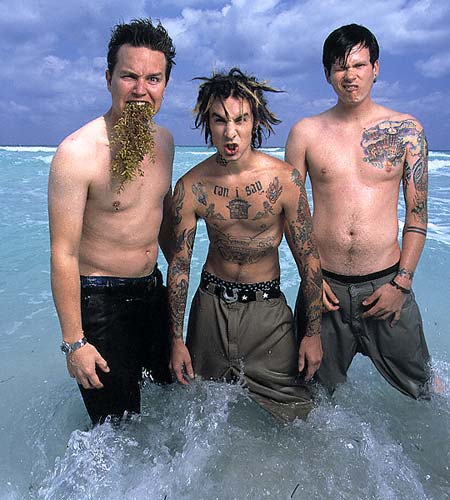
The notion of a guilty pleasure is a strange and degraded one. Obviously, there are things that you can't admit to in polite company, things that don't fit the criteria that society and you yourself set for enjoying things. But in admitting to a guilty pleasure, you are exposing these hidden passions - for this reason, people are squeamish about what they reveal. They might admit liking Eastenders or Desperate Housewives, but never Blink 182. Their bassist has a mouthful of fucking seaweed in the picture above, for crying out loud, and the album I'm writing about is called 'Enema of the State'.
Nevertheless, each of us has enjoyed music that seems repugnant in hindsight. Revisiting 'Enema of the State', the depth and breadth of sexism and puerility on display is truly shocking. Nu-metal, and the more sprightly and appealing pop-punk that developed alongside it at the beginning of this decade was in many ways the nadir of the macho posturing inherent in rock - a mixture of sweaty male bonding and inane self-pity that's truly off-putting to anyone with an ounce of decency.
However, I would argue that Blink 182's approach renders them a partially defensible pleasure. Unlike Limp Bizkit, Blink 182 have enough sense to make themselves the butt of the joke. The frat-house nonsense that infects the album is punctured by songs like 'What's My Age Again?', which demonstrates a degree of self-knowledge and self-doubt that makes the homophobia and sexism a bit more palatable. There's also a clear pop sensibility at play, which made the music an anathema to dull, mohawked punks and the traditional tween audience of pop. Their relative musical and lyrical idiocy also leads to the inclusion of a genuinely pathetic and upsetting song about teen suicide (appalling punks with the use of keyboards).
This was Blink 182's musical highpoint, and it's been downhill from there. The traditional cliché about American culture (oft-spouted by the BBC) is that the American Dream remains upstanding, despite the many disproofs that exist. The pop-punk version of the American Dream as presented by 'Enema of the State' seems closer to the fact - myriad flaws and disgusting attitudes, covered by a surface sheen that is, in my case, irresistible.
Monday, 20 July 2009
There's a good war!
The War in Afghanistan, being the new focus of the US and UK, is quickly shooting up the agenda. Much of the debate recently has focused on the lack of equipment for our boys, primarily the lack of helicopters. There should be a massive increase in helicopters, and they should be used to lift 'our boys' out of a depraved war. The focus given to Afghanistan by President Obama and the increasing severity of the situation in 'Af-Pak' has led to a rather fine upsurge of oppositional literature on the topic. Firstly, Tariq Ali's general piece from 2007, in the beautifully presented, but ever infuriating New Left Review and his more Pakistan-focused 'diary' in this fortnight's London Review of Books. Hitting a more rabble-rousing and less self-obsessed note is Jonathan Neale's wonderfully simple overview of the issues, actors and factors that make up the situation. The feat of this piece is that an 8-year-old could come out the other end of it, and know more about Afghanistan than George W. Bush.
Finally, and on a more bloggy note, the magnificently named Lenin on the crassness of the inevitability argument - a kind of Vietnam syndrome of the left, where any war in difficult territory, with an opposition, will lead to US defeat. The comments section is, as always, worth reading - proof that, however problematic the anti-Iraq war campaign was, the left remains capable of losing its bearings faced with 'the Good war'.
Finally, and on a more bloggy note, the magnificently named Lenin on the crassness of the inevitability argument - a kind of Vietnam syndrome of the left, where any war in difficult territory, with an opposition, will lead to US defeat. The comments section is, as always, worth reading - proof that, however problematic the anti-Iraq war campaign was, the left remains capable of losing its bearings faced with 'the Good war'.
Monday, 6 July 2009
Album of the Week: 'What's Going On?'

A while back, I ranted, without much control, on the subject of 'New Atheism'. Listening to 'What's Going On?' this week, I realised that those words were wasted (well, more than usual) given that the stupidity of the New Atheists can be summed up by the fact that they refuse to recognise the difference between the Christianity of Pope Benedict XIV and Marvin Gaye.
'What's Going On?' is correctly considered to be one of the greatest albums ever made, and there is a narrative traditionally associated with it, usually featuring the unheard-of political radicalism of it, as a Motown release. The film Dreamgirls, about Diana Ross and the Supremes, features a subplot where a Gaye soundalike's vision rubs up against the boss of the Motown-alike record label - leading 'Gaye' down a path of heroin use, and towards death. The inanity of the music that the soundalike produces is hilarious - 90% of the lyrics being the words "peace and love" - and this is before we take into account that 'Gaye' is played by the foul Eddie Murphy - but I digress...
The real surprise of the album, after imbibing the traditional narrative, and hits used for the illustration of it, is the level of introspection, and religious content that 'What's Going On?' contains. The left-wing politics is wonderful - gloriously earnest, exalting "picket lines/and picket signs" and those whose "hair is long". These gems are sanctified and sillified by the inclusion of a recurring prayer that begins "Don't go and talk about my father/God is my friend (Jesus is my friend)", which puts one in mind of both Gaye spoiling for a pub fight with a trash-talking atheist, and Gaye's own father, who tragically shot his son, depriving the world of black music of one of its greatest stylists, and perhaps its greatest singer since Paul Robeson. The music is profoundly soft, unthreatening, with melotrons and flutes spiralling to the heavens, drums that resemble a babbling brook, and grand, simple strings.
Listening to the album, the picture that emerges (much like that of Thom Yorke's 'The Eraser') is of a troubled soul, projecting his crises onto a disturbing, broken world. But a continuity exists with his earlier work, which unlike that of Thom Yorke, is not entirely depressing. So the lush, swinging 'Mercy Mercy Me (The Ecology)' comes on like a love song, then begins "Oh, mercy mercy me/things ain't what they used to be/Where did all the blue skies go?/Poisoned is the wind that flows/From the North and South". On 'Right On', he bemoans inequality, and his own addiction to easy living and nightlife (and perhaps cocaine - I don't have a good Gaye timeline), despite the horror of the world.
The litany of apocalyptic scenarios contrasted with appeals to God's love present us with something more complex than simple love songs, or political tracts. We're left with love songs which accept a world where love is crushed under the jackboot, songs of beauty and ecstacy in a world of squallor, songs that appeal to our highest impulses, while accepting that the easy way out is very easy indeed. It deserves its status, and deserves better than Eddie Murphy.
Tuesday, 30 June 2009
Oh, What a Lovely War!
Tomorrow, US troops will 'pullback' from towns and cities in Iraq. Good taste surely dictates that the celebrations will be muted - throwing a giant parade, given the million dead and 2 million displaced, would be quite grotesque (I foolishly searched for an image for this post, using the terms 'Iraq War' - not a clever move). The Iraq War (or 'Iraq 2 - This Time, It's Protracted') is seen, by all other than the most ostrich-like supporters of the invasion, as an unmitigated disaster - the deposition and execution of Saddam being scant consolation for the utter destruction of infrastructure, the creation of a sham 'democracy' and the unleashing of inter-communal violence. All of the main governmental supporters of the war: Bush, Blair and Aznar, are now out of office.
The election of an American President who was opposed to the war, and the 'pullback', are drawing a line under the invasion - continued criticism of the war will henceforth appear to be, if not sour grapes, then an increasingly irrelevant irritant. Of course, US troops remain in Iraq, as will the aircraft that rain fire indiscriminately and the branches of KFC. The message is that it's over - the massage of the message from the pro-war crowd will be "we came with good intentions, but got it wrong. Better luck next time!". They'd prefer not to learn the lessons, as they didn't after Kosovo, as they won't after Afghanistan. It's a shame, as I maintain a sedentary lifestyle, and really hate marching, even against war, but needs must.
One problem for the anti-war movement is film. The director and critic Francois Truffaut argued that it is impossible to make an anti-war film, as film can't fail but make look war look exciting. I've always taken this argument as fact - if we look at Apocalypse Now!, all 'the horror, the horror' is balanced with wide shots of helicopters, Flight of The Valkyries and that. Platoon, despite Oliver Stone's pinko-commie ways, leaves us with a slo-mo death scene that makes the chemical squalor of US conduct in Vietnam seem like the greatest heroism. But the Iraq War, for all the horror it's wrought, has left us with a genuinely anti-war film in the form of Paul Haggis' mesmeric 'In The Valley of Elah'.
'In The Valley of Elah' achieves its stance against the war by not setting its film in Iraq - the battered country is only seen in cameraphone footage, grimly reminiscent of leaked footage of so much atrocity. However, Iraq has come home - the film is set on a sunblasted army base, as disconnected from the US as the troops stationed thousands of miles away. Tommy Lee Jones plays the protagonist, the father of an Iraq veteran, and the narrative takes the form of a police procedural. The heavy lifting of the piece is undertaken by Tommy Lee's face, shown in nearly perpetual close-up, and his face's performance is magnificent. It's been said of the jazz pianist Cecil Taylor that he's capable of playing different tempo, tone and volume on each finger. In 'Elah', Tommy Lee Jones does the same thing with each facial muscle.
The film is remarkable for its portrayal of soldiers as human beings. Despite the millenia old existence of armies, this remains a difficulty (see the film '300' if you don't believe me). Perhaps it's because the things which armies do are beyond human - it's hard to believe that the people who razed Fallujah are of made of flesh like ours. But they are - they drink, they fight, they cry, they grieve and love. In a sane society, we wouldn't need an Armed Forces Day, or a Veterans' Day. We'd simply remove these individuals from the hideous situations in which they are placed, and carry about our business.
In dealing with the aftermath of war, 'In The Valley Of Elah' makes war as unsexy as it should be, and by implication, makes the decision to prosecute wars of choice seem as psychotic as it truly is. The film is problematic in its almost exclusive focus on the suffering of Americans. This is an imbalance that we can presume will exist until Iraq becomes the Las Vegas on the Gulf that we are promised. But in its unflinching portrait of what becomes even of the prosecutors of war, it deserves attention and acclaim.
The election of an American President who was opposed to the war, and the 'pullback', are drawing a line under the invasion - continued criticism of the war will henceforth appear to be, if not sour grapes, then an increasingly irrelevant irritant. Of course, US troops remain in Iraq, as will the aircraft that rain fire indiscriminately and the branches of KFC. The message is that it's over - the massage of the message from the pro-war crowd will be "we came with good intentions, but got it wrong. Better luck next time!". They'd prefer not to learn the lessons, as they didn't after Kosovo, as they won't after Afghanistan. It's a shame, as I maintain a sedentary lifestyle, and really hate marching, even against war, but needs must.
One problem for the anti-war movement is film. The director and critic Francois Truffaut argued that it is impossible to make an anti-war film, as film can't fail but make look war look exciting. I've always taken this argument as fact - if we look at Apocalypse Now!, all 'the horror, the horror' is balanced with wide shots of helicopters, Flight of The Valkyries and that. Platoon, despite Oliver Stone's pinko-commie ways, leaves us with a slo-mo death scene that makes the chemical squalor of US conduct in Vietnam seem like the greatest heroism. But the Iraq War, for all the horror it's wrought, has left us with a genuinely anti-war film in the form of Paul Haggis' mesmeric 'In The Valley of Elah'.
'In The Valley of Elah' achieves its stance against the war by not setting its film in Iraq - the battered country is only seen in cameraphone footage, grimly reminiscent of leaked footage of so much atrocity. However, Iraq has come home - the film is set on a sunblasted army base, as disconnected from the US as the troops stationed thousands of miles away. Tommy Lee Jones plays the protagonist, the father of an Iraq veteran, and the narrative takes the form of a police procedural. The heavy lifting of the piece is undertaken by Tommy Lee's face, shown in nearly perpetual close-up, and his face's performance is magnificent. It's been said of the jazz pianist Cecil Taylor that he's capable of playing different tempo, tone and volume on each finger. In 'Elah', Tommy Lee Jones does the same thing with each facial muscle.
The film is remarkable for its portrayal of soldiers as human beings. Despite the millenia old existence of armies, this remains a difficulty (see the film '300' if you don't believe me). Perhaps it's because the things which armies do are beyond human - it's hard to believe that the people who razed Fallujah are of made of flesh like ours. But they are - they drink, they fight, they cry, they grieve and love. In a sane society, we wouldn't need an Armed Forces Day, or a Veterans' Day. We'd simply remove these individuals from the hideous situations in which they are placed, and carry about our business.
In dealing with the aftermath of war, 'In The Valley Of Elah' makes war as unsexy as it should be, and by implication, makes the decision to prosecute wars of choice seem as psychotic as it truly is. The film is problematic in its almost exclusive focus on the suffering of Americans. This is an imbalance that we can presume will exist until Iraq becomes the Las Vegas on the Gulf that we are promised. But in its unflinching portrait of what becomes even of the prosecutors of war, it deserves attention and acclaim.
Sunday, 28 June 2009
Album of the 'Week': 'Off The Wall'

Amongst all the tearful tributes, Jackson radio marathons and sick jokes (my personal favourite being the most simple - "R, I, P - easy as 1, 2, 3"), a gradual chorus has emerged that regardless of his manifest personal problems, we should concentrate on 'the music'. This is easier said than done, because Jackson's musical decline was pretty much unsurpassed. The dull grandstanding of his later career was a product of one thing - the poor musical and lyrical instincts of the all-powerful Jackson. The greatest parts of his work were all the products of outside influences - the magnificent Jackson 5 records, with tiny Michael's breathtaking vocals backed by Motown session players fucking around on a slow day, and the first two albums with Quincy Jones, 'Off The Wall' and 'Thriller'.
For someone devoted to Top Of The Pops around the time of 'Earth Song' and 'You Are Not Alone', 'Off The Wall' was a genuine surprise - the largest surprise being the sheer aggression underpinning the best tracks. Not only is Jackson's singing not devoid of character, as it was to become, but he fucking goes for it. The insane falsetto of 'Don't Stop 'Til You Get Enough' and the joyous shouting of the title track (with the lyric "living crazy/that's the only way" - a sentiment he took far too literally) are reminders that he was a truly great singer, although, in contradiction to what various cloth-eared pundits have been repeating over the last few days, nowhere near as talented a musician as Mozart and Beethoven. Despite the hyperbole, the soft cloud of harmonies on 'Rock With You' are the closest he, and probably pop music to that point, got to the ecstatic.
Musically, the album pre-dates Jackson's personal and musical flight from his race. The sheer funk of the album, is, again a surprise. The nervy, jumping bassline of the title track, and the iron grooves that pervade the album are a wonder, and mostly the product of Quincy Jones's invention. The subtle, sane use of electronics are probably attributable to this as well - the Quincy-less Jackson would end up sanctioning the terrible production of 'Man In The Mirror'. Strings are used as simply another element, and not the point of the song, as they are at worst.
Given the hundreds of thousands of words written about Jackson following his odd death (there are many more to come...), this post feels oddly truncated. But perhaps the greatest tragedy is that, from 'Thriller' in 1983, his story overwhelmed his music, and, in musical terms, he'd died a very long time ago.
Thursday, 18 June 2009
Album of the 'Week': 'Journal For Plague Lovers'

The Manic Street Preachers are, as Simon Price argues in his brilliant and infuriating masterwork 'Everything', the band that mattered the most to their fans since The Smiths. Arguably this title was wrestled from them by The Libertines, partially because The Libertines are more interesting in terms of narrative, but largely because of the Manics' truly staggering backslide in terms of musical quality.
From 1994's 'The Holy Bible' to 1999's 'This Is My Truth, Tell Me Yours' (an album with a title long enough to merit a comma) the Manics made scythingly beautiful pop music, allied to gauché and memorable lyrics - their grandiosity and naivité making them the perfect antidote to Britpop's music-hall/football crowd stylings. Then came one of the worst albums ever made by a great band, and my personal departure from the Manics, 'Know Your Enemy'. Mere words cannot describe how shit the album is, but they can go some way. It was clattering, pretentious, ugly and stupid - it contained songs defending the former Soviet Union and attacking Royal Correspondents (how controversial!). This album was trailed as a return to form - it arrived as a terrible disappointment. I'd like to deride the albums released since 'Know Your Enemy', but I've scarcely heard them - they have some good songs, but that does not make them worth weathering.
So, another album, another return to form. 'Journal For Plague Lovers' re-engaged the music press and lapsed fans through a wonderful piece of grave-robbing, using for its lyrics notebooks bequeathed to the band by missing lyricist and guitarist Richey Edwards. The look and sound of the album is clearly based on that of 'The Holy Bible', the last Edwards-era Manics album, and it delivers on the promise. If it's merely an exercise in nostalgia, it's an exercise which has led them back to the well of decent music, from the lake of shite where, for a decade, they have pitched camp.
The lyrics of 'Journal For Plague Lovers', compared to their contemporaries used on 'The Holy Bible', lack density and focus. Whereas 'The Holy Bible' offers lists of demagogues, 'Journal For Plague Lovers' gives us jokes - "me and Stephen Hawking...we missed the Sex Revolution when we failed the physical". Some of the lyrics would have benefited immensely from being left in the book - Doors Closing Slowly's opening couplet "Realise how lonely this is/Self-defeating? Oh fuck yeah" is one of the worst lyrics ever committed to tape. There are still flashes of brilliance - "the Levi jean will always/be stronger than the Uzi" being a particular favourite - but the lyrics feel like what they are - the unwisely opened notebooks of a sadly insane man.
What has kept me listening to this album is what keeps all fans of the Manics listening to the Manics - the world-beating songwriting and singing of James-Dean Bradfield. On 'Journal For Plague Lovers' the discrepency in quality between the two elements of the songs becomes absurd. On 'Me and Stephen Hawking', James-Dean's giddy verses, sung at the edge of his vocal range, are a joy - the lyrics, including the phrase "Transgenic milk containing human protein", are an irritant. The anthemic 'Jackie Collins Existential Question Time' has a lyric which at first is amusing and becomes, through repetition, an annoyance ("if a married man fucks a Catholic"). But, give or take a few skipables, the Manics have made an album that repays listening, a fact as wonderful as it is unnerving.
Subscribe to:
Posts (Atom)
