Monday, 19 October 2009

Thick, White and Unsavoury


The BNP, following their winning of 2 seats in June's European elections, have had unprecedented media coverage, particularly from the BBC. Radio 1's dumbed-right-down-to-the-ground 'wicked' news flagship 'Newsbeat' conducted unchallenging interviews with two young BNP cadres, one of whom, Mark Collett, was caught on a BBC documentary half-a-decade ago claiming that AIDS was a friendly disease because it kills Africans and homosexuals, or 'blacks and gays'. Radio 1 now has the unique selling point of being the only radio station on earth to have placed genocidal racists alongside Beyoncé.

This Thursday, the party's leader, Nick Griffin, is slated to appear on Question Time. When questioned on this, the BBC has claimed that his status as elected representative of a vast swathe of Northern England makes him a suitable candidate for debate. Fair enough, but Nick Griffin represents not just the most bigoted voters in the North West, but a party which adheres to the tradition of classical anti-semitism, historical fascism, and, most importantly, engages in street-fighting, racist attacks and intimidation.

The BNP are now at pains to deny these last two facets of their tradition, and no longer march and rally in ethnic minority areas, in the way which Nick Griffin MEP and Andrew Brons MEP used to as members of the National Front. The tactic they now use is as old as the political party - to do unsavoury things under a different name. And fuck me, quite how unsavoury was a genuine shock.

The above photo is of an event which I witnessed, the EDL (English Defence League) demonstration in Swansea. What are they angry about? What have you got? According to a farcical press conference held for the benefit of Newsnight, the swastika (which they burned). According to the above photo, and the evidence of my own eyes, 'No Swastika' flags being hung in their vicinity.

Less flippantly, they're angry about Muslims. This is the most acceptable form of racism in our time, as it is supposedly against an ideology rather than a specific racial group. The EDL powerfully demonstrated the idiocy of well-meaning liberals and leftists of a particular stripe (you know, those left-wingers who are terrified of Islamofascism and its swarthy practicioners?) who follow this line of argument by screaming abuse at a young Asian woman who dared look at their demonstration from a rooftop. They did not ask whether she was an adherent of Islam before kicking off.

The EDL claims from the BNP - hilariously, on one of their first demonstrations, they carried placards reading 'We Are Not The BNP'. This is only hilarious because of its demonstrable falsehood. Not only are many of the EDL's members (although this is hard to check, because it's more of a flashmob racist rabble than an organisation) BNP members, it is utterly connected by talking-point to the BNP. So, for example, the BNP has recently flipped to a position of support for Zionism, because of its focus on the Muslim threat - the EDL, on their Manchester jaunt, carried placards reading 'Defend Israel's Right To Exist'. Consider this in the light of their burning of the No Swastika flag, it's baffling. Then remember that the EDL models after the BNP, and it becomes obvious. The EDL is the BNP Boot Boy Corps - they protest too much for it to be otherwise.

I was there as part of the much larger counter-demonstration, and, despite the moments of terror, I'm glad I was. Although not of the school of thought that you should trek to the North Pole before claiming with confidence that it's cold, it was instructive to see fascism first hand. Seig Heil-ing, spitting, threatening fascism. Boggle-eyed, unthinking, hateful racism. The idea that the BBC would bring it into people's fucking homes, and treat a Holocaust denier as though he's a normal politician, is nearly beyond comprehension.

Thursday, 1 October 2009

Album of the 'Week': Fear of a Black Planet


Public Enemy are ludicrous. I possess the first issue of the Public Enemy comic, from 2007, in which Chuck D fires up a young, disillusioned black man to fight authority, and, I seem to remember, ninjas. The character voices awestruck approval at the revelatory and liberatory power of Public Enemy's music and Chuck D's public speaking before, during, and after fighting the power. All this would be fine if this was charmingly ill-thought out fan-fiction, but the author of the comic is Chuck D himself. Public Enemy have developed into a middling band of overly earnest, politically confused old men, which would be fine, if they didn't have the most musically radical back catalogue of any popular band of the last 30 years.

'Fear of a Black Planet' is often referred to as the first hip-hop concept album, but it is nothing of the sort. Politically confused, over-long and patchy, there is no concept that can be said to guide the piece. The driving force of the album is utter rage. Rage at the band's detractors, rage at homosexuals, rage at race mixers, at Hollywood, and, finally, 'the power'. Rage breeds incoherence, and, coming to 'Fear of a Black Planet' decades after its release, with its reputation as the apex of politically engaged hip-hop, the unpalatable depths of homophobia and (perfectly understandable) race-hatred were shocking, but not as shocking as the sheer fragmentation of Chuck D's lyrics. It's difficult to discern a thread in any of the lyrics. This is in no way a criticism, it renders his writing a collection of placard slogans and a mass of phrases, delivered in his college-trained radio announcer voice. It does however, get a bit much - Ice-T's verse in 'Burn, Hollywood, Burn' (which can be said, with fair confidence, to have predicted the L.A Riots of 1992) actually arrives as light relief, even when he shouts "don't fight the power/(gunshot) the motherfucker!".

The lyrics are the transcription of a riot of ideas, influences and emotions. They form new beats, get sidetracked, alternate between self-pity and bombast. One of the masterpieces of the album, 'Welcome to the Terrordome' begins "I've got so much trouble on my mind/Refuse to lose". The lyrics as a whole betray a seige mentality, following the controversy created by the band's conduct (particularly Professor Griff's claim that "Jews are responsible for 90% of the evil in the world today" a wonderfully precise bit of utter nonsense), and reflect the broader seige mentality of a black community seeing the gains of the civil rights era rolled back by Reaganomics. The shifting rhythm and shock phrase-turning ("brain game, intellectual Vietnam", "subordinate terror kicking off in error", "most of my heroes don't appear on no stamp") and the authoritative delivery make avoiding engaging with the lyrics impossible. They force debate. That MLK and various faceless nameless orators appear in sample makes this even more delicious.

This, however can be said of any number of earnest rappers. What gives 'Fear of a Black Planet' its continued shock power and enduring status isn't the healthy dose of Louis Farrakhan-era Nation of Islam politics or Chuck D's self-pity, but the mindblowing production of The Bomb Squad. As opposed to the fast majority of hitherto existing hip-hop, each track is through-composed, and the album contains thousands of micro-samples. At one point (the first 20 seconds of the gloriously titled 'Anti-Nigger Machine'), the level of abstraction resembles John Cage's 'Williams Mix'. This alone makes the buffoon I saw perform his rap version of Elton John's Tiny Dancer look even more like an arse. But there's more - the vast majority of the tracks have no tonal centre - no student will ever be able to perform 'Fight The Power' in an ironic fashion at an open-mic night.

But most importantly, the production embraces what devotées of anologue call 'the digital squelch' and computer sequencing (Chuck D even namechecks the Mac on which the album was presumably made). 'Fear of a Black Planet', despite its 'classic' status, belongs to an old school of hip-hop that purists and modern practitioners like to imagine doesn't exist - one that isn't identifiably old, and is directly politically confrontational. The wonder of 'Fear of a Black Planet is that not only has it not dated, but it sounds as though it could have been released in the distant future.

Monday, 31 August 2009

Kyleology


A judge once famously described the Jeremy Kyle Show as 'a human form of bear-baiting'. While critics of the show often cite this as a definitive and apposite description of its horror, it falls into a trap of the show's making. In order for Kyle's piece of shit to be broadcastable, its participants have to be made to seem subhuman, animalistic - at best childlike, requiring Kyle's care. In fact, if we're going 19th century in our comparisons, the Jeremy Kyle Show is a reincarnation of Bedlam, where damaged people are exposed for the entertainment of others. It is a form of pornography - a pornography of aggression and misery (not exactly the most fun kind).

What is interesting about the show is not the horror displayed, but the strategies used to legitimate the display of horror. Prime among these is a thin tissue of theraputic credibility. The entire show is framed as an attempt to reconcile warring parties. This is of course utterly unbelievable - even accounting for editing, the participants have at most 45 minutes of Kyle's shock therapy. Given that many of the participants have come to the show in an attempt to rid their lives of conflict, his abrasive style can be assumed to be of very little use.

The show implicitly accepts this, and so Kyle often speaks of the 'Aftercare' team headed by the gentle Northern 'Good Cop' Graham. Aftercare is an apology for Kyle's aggression, the flowers after the wife-beating. Interestingly, we're near as fuck never told how the participants fared during, or following Aftercare. Instead of any meaningful engagement with the guests and their experiences, Kyle spends around 5 minutes of his alloted hour making Graham's healing powers sound as profound and (we can assume) realistic as those of Jesus Christ.

The second and more politically interesting justifying strategy applied to make Kyle's Marvellous World of Madfolk acceptable is one of class. Kyle is a militant member of the middle-class. Kyle makes his class war obvious - the frequency with which he abstractly calls on the state to intervene against his guests ('This, Mr. Brown, is what's wrong with this country') is truly frightening. The entire texture of the show pits his ill-fitting business suits and recieved pronounciation against the ill-fitting (in a different direction) brightly-coloured sportswear and regional accents of his guests. Kyle's show used to largely consist of him screaming "GET A JOB!!!" at poor and/or drug addicted and/or mental ill guests - although this has wisely desisted since The Crunch hit and unemployment rocketed.

Ultimately, class provides the key to comprehending the Jeremy Kyle Show. The late Aneurin Bevan once wrote that 'around the meagre tables, in the small rooms of the poor, bitter hells of wounded vanity and personal acrimony arise'. Stuck in an ex-industrial town (so many of the guests are from Yorkshire, urban Scotland or South Wales that it's frightening) with no job and little prospect of gaining one, short of escape, turning to drink, drugs or a drastically destructive relationship is all too attractive. In fact, aside from these broadcastable vices, the poorer or more (whisper it) working class you are, the younger you will die, after having led a less healthy more miserable life. The Jeremy Kyle Show's 'Bad Cop, Good Cop' routine mirrors that of New Labour, faced with the ongoing misery of the areas destroyed by Thatcherism - an ASBO, then a chromed city centre. The cause of this approach is a fundamental, and wilful ignorance of the roots and horrors of poverty. If Kyle and Brown don't understand, it's our job to make them understand that getting beaten up and getting flowers is demeaning, disgusting and should fucking stop.

Tuesday, 11 August 2009

On Burma

The international community (which as Chomsky has pointed out, simply means the US and UK, and subordinated NATO allies) has erupted over the extension of Aung San Suu Kyi's decades-old house arrest. By odd coincidence I've been reading an old John Pilger book named 'Hidden Agendas'. It's nice to bask in the World's Poshest Australian's glow, and magnificently portentous writing. It has also been nice to read about the islands of grotesque despotism that persist, despite the 'international community'. His account of Burma follows the pattern of his account of Cambodia, with well-meaning clichés about the beauty of the landscape, the humility and goodness of the people and so on. At one point, he refers to the deference of someone presumably terrified at the prospect of offending a foreigner during Burma's 'turn to tourism' as proof of an innate generosity. This isn't necessary - noone should have to live under a regime of slave and/or convict labour, in conditions of extreme deprivation, even if they're rude and live in a sequence of slimy caves.

The portrait given of Aung Syn Suu Kyi is more nuanced - having acquired a rare interview, he does the unimaginable and asks difficult questions. Solidarity with Third World oppositional movements often takes on a crude element of hero-worship - Mandela, the Dalai Lama - and it often feels like humbug to criticise this well-meaning projection. Pilger, having laid praise on thick, adds enough nuance to counter the cliché. In particular, he questions her on her proposal for a unity government with her jailers. John Pilger remains one of the world's great journalists, simply for the fact that he's conducted robust, critical interviews with two of the subjects (and my, what subjection!) in Gordon Brown's piss-poor, unsold book 'Courage'. In his greatest film, 'Apartheid Did Not Die', he has an actual argument with Nelson Mandela. It is impossible to imagine Andrew Marr doing the same.

However, what's been interesting about Burma is the issue's proof of how our politicians fall over themselves to criticise regimes in which they have very little interest. There's the simple propaganda argument, often heard around the time of the Iraq War, that Saddam's crimes were equivalent to the crimes of a myriad of other dictators, and thus he didn't deserve toppling. As solid as this argument is, it did lead to people who were opposed to the war saying things like "Well, why don't they sort out Mugabe?!". A narrow focus on human rights violations can lead to strange and contradictory statements - the 'comedian and activist' Mark Thomas wrote an article on Burma which praises, with massive qualification, America and the Conservative Party's stances on Burma. If you find yourself singing the praises of the armers of Indonesia and the bombers of Baghdad, you're missing the point.

The point is that horrors such as those committed by the Burmese junta are perfectly acceptable to major companies, smaller businesses and the 'international community'. Authoritarian capitalism is the norm for most of the world's population, from China to Honduras, and the horrors that the Burmese people suffer are entirely congruent with past and present horrors. The boycott and disinvestment campaign has been very effective, preventing whole American cities and states, and the EU to theoretical non-involvement with the Burmese government. Despite this, the regime persists. Aung Syn Suu Kyi, despite her Courage, will strive for national unity and the injustice that is 'peace and reconciliation'. The only action that will topple it is the action of the Burmese people themselves, battered and enslaved, and the only justice the Burmese people is that which they take in the heat of struggle, to the probable horror of the 'international community'. They have risen, despite their 'peaceloving' 'deference', and will rise again.

Tuesday, 21 July 2009

Album of the 'Week': 'Enema of the State'


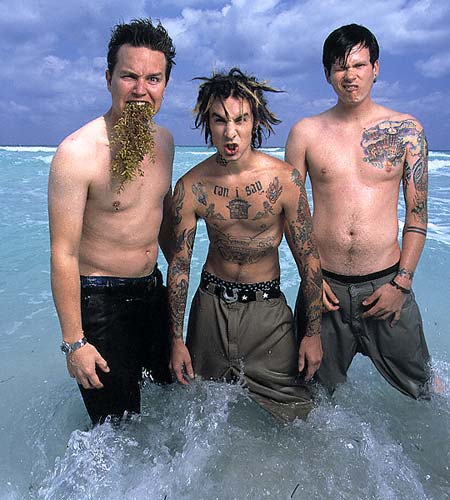
The notion of a guilty pleasure is a strange and degraded one. Obviously, there are things that you can't admit to in polite company, things that don't fit the criteria that society and you yourself set for enjoying things. But in admitting to a guilty pleasure, you are exposing these hidden passions - for this reason, people are squeamish about what they reveal. They might admit liking Eastenders or Desperate Housewives, but never Blink 182. Their bassist has a mouthful of fucking seaweed in the picture above, for crying out loud, and the album I'm writing about is called 'Enema of the State'.

Nevertheless, each of us has enjoyed music that seems repugnant in hindsight. Revisiting 'Enema of the State', the depth and breadth of sexism and puerility on display is truly shocking. Nu-metal, and the more sprightly and appealing pop-punk that developed alongside it at the beginning of this decade was in many ways the nadir of the macho posturing inherent in rock - a mixture of sweaty male bonding and inane self-pity that's truly off-putting to anyone with an ounce of decency.

However, I would argue that Blink 182's approach renders them a partially defensible pleasure. Unlike Limp Bizkit, Blink 182 have enough sense to make themselves the butt of the joke. The frat-house nonsense that infects the album is punctured by songs like 'What's My Age Again?', which demonstrates a degree of self-knowledge and self-doubt that makes the homophobia and sexism a bit more palatable. There's also a clear pop sensibility at play, which made the music an anathema to dull, mohawked punks and the traditional tween audience of pop. Their relative musical and lyrical idiocy also leads to the inclusion of a genuinely pathetic and upsetting song about teen suicide (appalling punks with the use of keyboards).

This was Blink 182's musical highpoint, and it's been downhill from there. The traditional cliché about American culture (oft-spouted by the BBC) is that the American Dream remains upstanding, despite the many disproofs that exist. The pop-punk version of the American Dream as presented by 'Enema of the State' seems closer to the fact - myriad flaws and disgusting attitudes, covered by a surface sheen that is, in my case, irresistible.

Monday, 20 July 2009

There's a good war!

The War in Afghanistan, being the new focus of the US and UK, is quickly shooting up the agenda. Much of the debate recently has focused on the lack of equipment for our boys, primarily the lack of helicopters. There should be a massive increase in helicopters, and they should be used to lift 'our boys' out of a depraved war. The focus given to Afghanistan by President Obama and the increasing severity of the situation in 'Af-Pak' has led to a rather fine upsurge of oppositional literature on the topic. Firstly, Tariq Ali's general piece from 2007, in the beautifully presented, but ever infuriating New Left Review and his more Pakistan-focused 'diary' in this fortnight's London Review of Books. Hitting a more rabble-rousing and less self-obsessed note is Jonathan Neale's wonderfully simple overview of the issues, actors and factors that make up the situation. The feat of this piece is that an 8-year-old could come out the other end of it, and know more about Afghanistan than George W. Bush.

Finally, and on a more bloggy note, the magnificently named Lenin on the crassness of the inevitability argument - a kind of Vietnam syndrome of the left, where any war in difficult territory, with an opposition, will lead to US defeat. The comments section is, as always, worth reading - proof that, however problematic the anti-Iraq war campaign was, the left remains capable of losing its bearings faced with 'the Good war'.

Monday, 6 July 2009

Album of the Week: 'What's Going On?'


A while back, I ranted, without much control, on the subject of 'New Atheism'. Listening to 'What's Going On?' this week, I realised that those words were wasted (well, more than usual) given that the stupidity of the New Atheists can be summed up by the fact that they refuse to recognise the difference between the Christianity of Pope Benedict XIV and Marvin Gaye.

'What's Going On?' is correctly considered to be one of the greatest albums ever made, and there is a narrative traditionally associated with it, usually featuring the unheard-of political radicalism of it, as a Motown release. The film Dreamgirls, about Diana Ross and the Supremes, features a subplot where a Gaye soundalike's vision rubs up against the boss of the Motown-alike record label - leading 'Gaye' down a path of heroin use, and towards death. The inanity of the music that the soundalike produces is hilarious - 90% of the lyrics being the words "peace and love" - and this is before we take into account that 'Gaye' is played by the foul Eddie Murphy - but I digress...

The real surprise of the album, after imbibing the traditional narrative, and hits used for the illustration of it, is the level of introspection, and religious content that 'What's Going On?' contains. The left-wing politics is wonderful - gloriously earnest, exalting "picket lines/and picket signs" and those whose "hair is long". These gems are sanctified and sillified by the inclusion of a recurring prayer that begins "Don't go and talk about my father/God is my friend (Jesus is my friend)", which puts one in mind of both Gaye spoiling for a pub fight with a trash-talking atheist, and Gaye's own father, who tragically shot his son, depriving the world of black music of one of its greatest stylists, and perhaps its greatest singer since Paul Robeson. The music is profoundly soft, unthreatening, with melotrons and flutes spiralling to the heavens, drums that resemble a babbling brook, and grand, simple strings.

Listening to the album, the picture that emerges (much like that of Thom Yorke's 'The Eraser') is of a troubled soul, projecting his crises onto a disturbing, broken world. But a continuity exists with his earlier work, which unlike that of Thom Yorke, is not entirely depressing. So the lush, swinging 'Mercy Mercy Me (The Ecology)' comes on like a love song, then begins "Oh, mercy mercy me/things ain't what they used to be/Where did all the blue skies go?/Poisoned is the wind that flows/From the North and South". On 'Right On', he bemoans inequality, and his own addiction to easy living and nightlife (and perhaps cocaine - I don't have a good Gaye timeline), despite the horror of the world.

The litany of apocalyptic scenarios contrasted with appeals to God's love present us with something more complex than simple love songs, or political tracts. We're left with love songs which accept a world where love is crushed under the jackboot, songs of beauty and ecstacy in a world of squallor, songs that appeal to our highest impulses, while accepting that the easy way out is very easy indeed. It deserves its status, and deserves better than Eddie Murphy.